Zhao Ziyang Public Speech at the Tiananmen Square Protest of 1989

20131112tu-zhao-ziyang-tiananmen-square-speech-1989-640x360

Zhao Ziyang was general secretary for little more than a year before the death of Hu Yaobang on 15 April 1989, coupled with a growing sense of public outrage caused by high inflation, provided the backdrop for the large-scale protest of 1989 by students, intellectuals, and other parts of a disaffected urban population. The Tiananmen protests initially began as a spontaneous public mourning for Hu, but evolved into nation-wide protests supporting political reform and demanding an end to Party corruption.

Student demonstrators, taking advantage of the loosening political atmosphere, reacted to a variety of causes of discontent. The diverse demands of protesters included greater economic liberalization, political democracy, media freedom, freedom of speech and association, rule of law, and to have the legitimacy of the movement recognized. Some protest leaders spoke against official corruption and speculation, price stability, social security, and the democratic means to supervise the reform process. Ironically, some of the original invective was also directed against Zhao. Party hardliners increasingly came to the conclusion that the demonstrations were due to Zhao’s rapid pace of reform, which they believed caused a sense of confusion and frustration among college students. Protests also spread through many other cities, notably including Shanghai and Guangzhou. The protesters may have been encouraged by the imminent collapse of other Communist government in Eastern Europe.

The tragic events of the Tiananmen Square protests of 1989 sealed Zhao’s fate and rendered impossible any further democratic movement. While he was paying an official visit to Pyongyang, the party hard-liners exploited the opportunity to declare the ongoing protests “counter-revolutionary.” Upon returning from Pyongyang, Zhao made several attempts to steer the course toward what he called “a track based upon democracy and the rule of law”. He opened up channels for direct dialogues between students and the government at multiple levels. He also ordered the news media to cover the student demonstrations with unprecedented openness. A number of legislative initiatives aimed at the reform of press, news media and education were also under way. However, Zhao’s initiatives, along with his conciliatory attitude toward the students, were seen by the elders and other party hard-liners as hastened steps toward breaking free the party control. The evening of 16 May marked the point of no return of Zhao’s political career. At the onset of his meeting with the visiting Soviet leader Mikhail Gorbachev, Zhao made a stunning announcement declaring that Deng Xiaoping, though officially no longer a member of the party central committee, was still having final say in major decision-making. Zhao’s move was interpreted by Party elders as an unmistakable sign of parting company with the aging paramount leader, his long-time political patron and mentor. The leadership would not purge Zhao while Gorbachev was still in Beijing. But on the night of 18 May, just after the Soviet leader left, Zhao was summoned to Deng’s residence and a hastily called Politburo Standing Committee was called to endorse martial law with Zhao casting the lone dissenting vote.

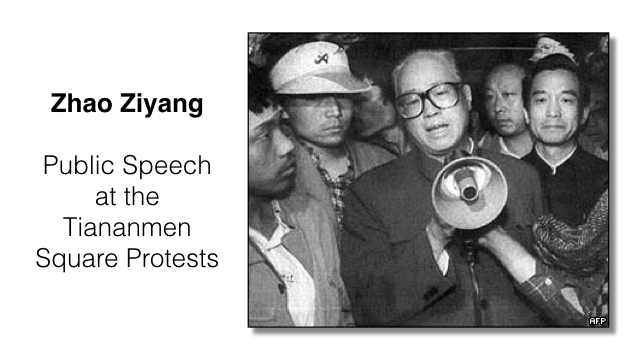
Shortly before 5 am on the morning of 19 May, Zhao appeared in Tiananmen Square and wandered among the crowd of protesters. Using a bullhorn, he delivered a now-famous speech to the students gathered at the square. It was first broadcast through China Central Television nationwide. Here is a translated version:

Students, we came too late. We are sorry. You talk about us, criticize us, it is all necessary. The reason that I came here is not to ask for your forgiveness. What I want to say is that you are all getting weak, it has been seven days since you went on a hunger strike, you can’t continue like this. As time goes on, your body will be damaged beyond repair, it could be very life-threatening. Now the most important thing is to end this strike. I know, your hunger strike is to hope that the Party and the government will give you a satisfying answer. I feel that our communication is open. Some of these problems can only be solved through certain procedures. For example, you have mentioned about the nature of the incident, the question of responsibility; I feel that those problems can be resolved eventually, we can reach a mutual agreement in the end. However, you should also know that the situation is very complicated, it is going to be a long process. You can’t continue the hunger strike longer than seven days, and still insist on receiving a satisfying answer before ending the hunger strike.

You are still young, there are still many days yet to come, you must live healthy, and see the day when China accomplishes the four modernizations. You are not like us, we are already old, so we do not matter. It is not easy for this nation and your parents to support your college studies. Now you are all about 20, and about to sacrifice your lives so easily, students, couldn’t you think rationally? Now the situation is very serious, you all know, the Party and the nation is very antsy, our society is very worried. Besides, Beijing is the capital, the situation is getting worse and worse everywhere, this cannot continue. Students, you all have good will, and are for the good of our nation, but if this situation continues, loses control, it will have serious consequences elsewhere.

In conclusion, I have only one wish. If you stop hunger strike, the government won’t close the door for dialogue, never! The questions that you have raised, we can continue to discuss. Although it is a little slow, but we are reaching some agreement on some problems. Today I just want to see the students, and express our feelings. I hope students could think about this issues calmly. This thing can not be sorted out clearly under illogical situations. You all have that strength, you are young after all. We were also young before, we protested, laid our bodies on the rail tracks, we never thought about what will happen in the future at that time. Finally, I beg the students once again, think about the future calmly. There are many things that can be solved. I hope that you will all end the hunger strike soon, thank you.

The protesters did not disperse. A day after Zhao’s 19 May visit to Tiananmen Square, Premier Li Peng publicly declared martial law. In the power struggle that ensued, Zhao was stripped of all his positions. Following Zhao’s dismissal, Jiang Zemin replaced Zhao as general secretary and successor of Deng Xiaoping. Jiang was notable for suppressing similar protests in Shanghai without any bloodshed.

What motivated Zhao remains, even today, a topic of debate by many. Some say he went into the square hoping a conciliatory gesture would gain him leverage against hard-liners like Premier Li Peng. Others believe he supported the protesters and did not want to see them hurt when the military was called in. After the incident, Zhao was placed under indefinite house arrest.

Zhao’s rival, Li Peng, later accused Zhao of fomenting the Tiananmen Protests exclusively for political gain. According to Li, “Zhao liaised with Bao Tong immediately after his arrival in Beijing (from Pyongyang). Bao gathered some other of Zhao’s supporters to hash out the situation. They feared that Zhao’s political future was at stake: Zhao did not succeed in [managing] the economy, was not stellar politically, does not have a power base of his own, and his son was suspected of illegal business dealings. As such, it was likely that Zhao would become the ‘scapegoat’ of the student movement. These advisors suggested to Zhao that he maintain distance with Deng Xiaoping [and] attempt to win the people’s hearts in order to save himself; there were no other options.” Because Zhao was never formally charged with any wrongdoing, it cannot be known what evidence Li had to support his claims. Zhao himself addressed Li’s claims as “slander”.

Zhao remained under tight supervision and was allowed to leave his courtyard compound or receive visitors only with permission from the highest echelons of the Party. There were occasional reports of him attending the funeral of a dead comrade, visiting other parts of China or playing golf at Beijing courses, but the government rather successfully kept him hidden from news reports and history books. Over that period, only a few snapshots of a gray-haired Zhao leaked out to the media. On at least two occasions Zhao wrote letters, addressed to the Chinese government, in which he put forward the case for a reassessment of the Tiananmen Massacre. One of those letters appeared on the eve of the Communist Party’s 15th National Congress. The other came during a 1998 visit to China by U.S. PresidentBill Clinton. Neither was ever published in mainland China.

After 1989, Zhao remained ideologically estranged from the Chinese government. He remained popular among those who believed that the government was wrong in ordering the “Tiananmen Massacre”, and that the Party should reassess its position on the student protests. He continued to hold China’s top leadership responsible for the assault, and refused to accept the official Party line that the demonstrations had been a part of a “counter-revolutionary rebellion”. After his arrest, Zhao eventually came to hold a number of beliefs that were much more radical than any positions he had ever expressed while in power. Zhao came to believe that China should adopt a free press, freedom to organize, an independent judiciary, and a multiparty parliamentary democracy.

Zhao lived for fifteen years under house arrest, accompanied by his wife. Thehutong in which Zhao lived had once belonged to a hairdresser of the Qing DynastyEmpress Dowager, Cixi, and was located in central Beijing, close toZhongnanhai. Despite Zhao’s house arrest, no formal charges were ever laid against him, and he was never expelled from the Communist Party. After his arrest, Deng and his successors continued to believe that Zhao and his subordinates had worked secretly to organize the nation-wide protests, and worried that his death might trigger protests similar to the protests sparked by the death of Hu Yaobang.

Death and muted response

In February 2004, Zhao had a pneumonia attack that led to a pulmonary failure and was hospitalized for three weeks. Zhao was hospitalized again with pneumonia on 5 December 2004. Reports of his death were officially denied in early January 2005. Later, on 15 January, he was reported to be in a coma after multiple strokes. According to Xinhua, Vice President Zeng Qinghong represented the party’s central leadership to visit Zhao at the hospital. Zhao died on 17 January in a Beijing hospital at 07:01, at the age of 85. He was survived by his second wife, Liang Boqi, and five children (a daughter and four sons).

After Zhao’s death, China’s leaders feared an episode of civil disturbance similar to that which followed the death of Hu Yaobang. In order to manage the news of Zhao’s death, the Chinese government created an “Emergency Response Leadership Small Group”, which declared “a period of extreme sensitivity”, and placed the People’s Armed Police on special alert. In order to prevent any mass demonstrations in the capital, the Emergency Group directed the Ministry of Railways to screen travellers headed to Beijing. Chinese newspapers carried a brief obituary, but Xinhua successfully directed China’s domestic TV and radio stations not to broadcast the news. In order to prevent any public commemoration of Zhao, Chinese authorities increased security in Tiananmen Square and at Zhao’s house.

Under the headline “Comrade Zhao Ziyang has Passed Away”, Zhao’s obituary stated, “Comrade Zhao had long suffered from multiple diseases affecting his respiratory and cardiovascular systems, and had been hospitalized for medical treatment several times. His conditions worsened recently, and he passed away Monday after failing to respond to all emergency treatment.” All Chinese newspapers carried exactly the same 59-word obituary on the day following his death, leaving the main means of mass dissemination through the Internet. Chinese Internet forums, including the Strong Nation Forum and forums hosted bySINA.com, Xinhua, and the People’s Daily, were flooded with messages expressing condolences for Zhao: “Time will vindicate him”, wrote one commenter; “We will miss you forever” wrote another. These messages were promptly deleted by moderators, leading to more postings attacking the moderators for deleting the postings.

The Chinese government was successful in keeping Zhao’s death fairly low key within mainland China. Open, public response was absent, though some online commenters stated that they planned to buy wreaths to mourn his death, or had stood in three minutes of silence to honour Zhao’s memory.

In Hong Kong, 10,000–15,000 people attended the candlelight vigil in remembrance of Zhao. Mainlanders such as Chen Juoyi said that it was illegal for Hong Kong legislators to join any farewell ceremony, stating “…under the ‘one country, two systems‘ a Hong Kong legislator cannot care anything about mainland China.” The statement caused a political storm in Hong Kong that continued for three days after his speech. Szeto Wah, the chairman of The Hong Kong Alliance in Support of Patriotic Democratic Movements in China, said that it was not right for the Communists to suppress the memorial ceremony. The twenty-four pan-democrat legislators went against the chairperson of the Legislative Council of Hong Kong, who insisted that security be tightened at Tiananmen Square and at Zhao’s house, and that the authorities try to prevent any public displays of grief. Similar memorials were held around the world, notably in New York City and Washington, DC where American government officials and exiledpolitical dissidents attended. In the West, Zhao was editorialized as a martyr who died for democracy.

On 29 January 2005 the government held a funeral ceremony for him at theBabaoshan Revolutionary Cemetery, a place reserved for revolutionary heroes and high government officials, that was attended by some 2,000 mourners, who were pre-approved to attend. Several dissidents, including Zhao’s secretary Bao Tongand Tiananmen Mothers leader Ding Zilin, were kept under house arrest and therefore could not attend. Xinhua reported that the most senior official to attend the funeral was Jia Qinglin, fourth in the party hierarchy, and other officials who attended included He GuoqiangWang Gang and Hua Jianmin. Mourners were forbidden to bring flowers or to inscribe their own messages on the government-issued flowers. There was no eulogy at the ceremony because the government and Zhao’s family could not agree on its content: while the government wanted to say he made mistakes, his family refused to accept he did anything wrong. On the day of his funeral, state television mentioned Zhao’s death for the first time. Xinhua issued a short article on the funerary arrangements, acknowledging Zhao’s “contributions to the party and to the people”, but said he made “serious mistakes” during the 1989 “political disturbance”. According to Du Daozheng, writing in the foreword to the Chinese edition of Zhao’s memoirs, the use of the term “serious mistakes” instead of the former verdict of “supporting turmoil and splitting the party” represented a backing down by the party. After the ceremony, Zhao wascremated. His ashes were taken to his Beijing home, since the government had denied him a place at Babaoshan.

Push for rehabilitation

After Zhao’s death, there were a number of calls in China and abroad urging China to reconsider Zhao’s role in history. Within China, these calls were largely led by Zhao’s former secretary, Bao Tong. Outside of China, Zhao’s death produced calls from the governments of Taiwan and Japan urging China to move toward granting the greater political freedoms that Zhao promoted. The Japanese prime minister, Junichiro Koizumi, said as part of a statement on Zhao’s death: “I want them to make efforts for democratization”. A representative of the Taiwanese cabinet, Chen Chi-mai, stated that Beijing should “face the truth about Tiananmen Square” and “push for democratic reforms”. The White House praised Zhao, saying that Zhao “was a man of moral courage who suffered great personal sacrifices for standing by his convictions during difficult times.”

Although some of his followers have occasionally attempted to push for Zhao’s formal rehabilitation since Zhao’s arrest, the Party has been largely successful in removing his name from most public records available in China. Government efforts to delete Zhao’s memory from public consciousness include airbrushing his picture from photographs released in China, deleting his name from textbooks, and forbidding the media from mentioning him in any way. In 2005, former NPC chairman Wan Li joined more than 20 retired Politburo members, including Tian Jiyun, former Vice Premier, in asking the Central Government to rehabilitate Zhao’s name and hold memorial services for him for his many important contributions to China. The Chinese government agreed to hold a ceremony to honor the late Communist Party chief Zhao Ziyang, but the response fell far short of satisfying the requests from both inside and outside the CPC.

Since 1989, one of the few publications that has dared to print a non-government-approved memorial praising Zhao’s legacy has been the magazine China Through the Ages (Yanhuang Chunqiu). The magazine released the pro-Zhao article in July 2010. The article was written by Zhao’s former aide, Yang Rudai.

__________

The above text is an excerpt from the Wikipedia page about Zhao Ziyan.

Great Kings, Leaders, Rulers, Monarchs, and Dictators

20131112tu-the-good-king-960x540

An honest and effective study of democracy must consider the positive outcomes of non-democratic forms of government. These other forms of government set a standard that the success of a democracy will be measured by. Democracy is a declaration that states, “We can govern ourselves. We don’t need a king and don’t want a dictator. As necessary we’ll elect competent people to handle governance.” The Declaration of Independence was literally such a statement.

Above is an image of King Wenceslas venturing out on a harsh winter day to feed the poor. There are many examples of benevolent and competent rulers throughout history. In some cases these good leaders were required to take power by force to overcome exploitative and oppressive regimes (enemies from within and without). As a result, the “Good King” has become a kind of trope in literature: “The Good King is honorable, virtuous, wise and understanding. He cares about his subjects no matter how seemingly unimportant they are and puts their well-being above his own. He governs the land fairly, is a Royal Who Actually Does Something and is often very modest about his rank and position.”

Below are some examples of leaders throughout history who, despite their failings and faults, offer an example of good leadership. The examples given below are of people who rose to power, perhaps without the initial support of the people. Though not democratically elected, some developed the respect and loyalty of their citizens. Those in the list below are not considered great because of military victories. Instead, their greatness is measured in the quality of life improvements they influenced.

  • Akbar the Great (14 October 1542 – 27 October 1605). “To unify the vast Mughal state, Akbar established a centralised system of administration throughout his empire and adopted a policy of conciliating conquered rulers through marriage and diplomacy. In order to preserve peace and order in a religiously and culturally diverse empire, he adopted policies that won him the support of his non-Muslim subjects. Eschewing tribal bonds and Islamic state identity, Akbar strived to unite far-flung lands of his realm through loyalty, expressed through a Persianised culture, to himself as an emperor who had near-divine status.” (source)
  • Ashoka Maurya (304–232 BCE). A benevolent leader, it is recorded in the Kalinga edicts, he addresses his people as his “children”, and mentions that as a father he desires their good. In the Edicts of Ashoka, although Buddhism and the Buddha are mentioned, the edicts focus on social and moral precepts, rather than specific religious practices or the philosophical dimension of Buddhism. The edicts describe in detail the Ashoka’s view about dhamma, an earnest attempt to solve some of problems that a complex society faced. The edicts convey Ashoka’s conversion to Buddhism, the description of his efforts to spread Buddhism, his moral and religious precepts, and his social and animal welfare program.
  • Augustus of Rome (23 September 63 BC – 19 August 14 AD). Augustus Caesar ruled as the Emperor of Rome for 41 years. During this time, Augustus improved the infrastructure and military of Rome. He also reformed the taxation process. His reign is known as Pax Romana, or Roman Peace, because during his reign diplomacy flourished.
  • Chandragupta Maurya (340 BC – 298 BC). “Chandragupta was influenced to accept Jainism by the sage Bhadrabahu; he abdicated his throne to spend his last days at the Shravana Belgola, a famous religious site in southwest India, where he fasted to death. Along with his grandson, Ashoka, Chandragupta Maurya is one of the most celebrated rulers in the history of India. He has played a crucial role in shaping the national identity of modern India, and has been lionised as a model ruler and as a national hero.”
  • Cyrus II of Persia or Cyrus the Great (576 BC–530 BC). “Cyrus the Great respected the customs and religions of the lands he conquered.[22] It is said that in universal history, the role of the Achaemenid empire founded by Cyrus lies in its very successful model for centralized administration and establishing a government working to the advantage and profit of its subjects.” (source)
  • Mao Zedong (26 December 26 1893 – 9 September 1976). “Mao remains a controversial figure and there is little agreement over his legacy both in China and abroad. Supporters generally credit him with and praised for having unified China and ending the previous decades of civil war. He is also credited with having improved the status of women in China and improving literacy and education.” (source)
  • Meiji of Japan (明治天皇 Meiji-tennō?, 3 November 1852 – 30 July 1912). “The Meiji period (明治時代 Meiji-jidai?), also known as the Meiji era, is a Japanese era which extended from September 1868 through July 1912. This period represents the first half of the Empire of Japan during which Japanese society moved from being an isolated feudal society to its modern form. Fundamental changes affected its social structure, internal politics, economy, military, and foreign relations.” (source)
  • Henry IV of France (13 December 1553 – 14 May 1610). “Henry IV proved to be a man of vision and courage. Instead of waging costly wars to suppress opposing nobles, Henry simply paid them off. As king, he adopted policies and undertook projects to improve the lives of all subjects, which made him one of the country’s most popular rulers ever. Henry is said to have originated the oft repeated phrase, ‘a chicken in every pot.’ He was a man of kindness, compassion, and good humor, and was much loved by his people.” (source)
  • Muhammed or Abū al-Qāsim Muḥammad ibn ʿAbd Allāh ibn ʿAbd al-Muṭṭalib ibn Hāshim (Arabic: محمد بن عبد الله بن عبد المطلب‎; c. 570 – c. 8 June 632). “Among the first things Muhammad did to settle down the longstanding grievances among the tribes of Medina was drafting a document known as the Constitution of Medina, ‘establishing a kind of alliance or federation’ among the eight Medinan tribes and Muslim emigrants from Mecca, which specified the rights and duties of all citizens and the relationship of the different communities in Medina (including that of the Muslim community to other communities, specifically the Jews and other ‘Peoples of the Book’).” (source)
  • Shivaji (Marathi [ʃiʋaˑɟiˑ bʱoˑs(ə)leˑ]; c. 1627/1630[2] – 3 April 1680). “Shivaji allowed his subjects freedom of religion and opposed forced conversion.[7][page needed] Shivaji also promulgated other enlightened values, prohibiting slavery in his kingdom,[citation needed] and applying a humane and liberal policy to the women of his state.” (source) Vivekananda stated, “Shivaji is one of the greatest national saviours who emancipated our society and our Hindu dharma when they were faced with the threat of total destruction. He was a peerless hero, a pious and God-fearing king and verily a manifestation of all the virtues of a born leader of men described in our ancient scriptures. He also embodied the deathless spirit of our land and stood as the light of hope for our future.” (source)
  • Suleiman I of the Ottoman Empire (6 November 1494 – 7 September 1566). “At the helm of an expanding empire, Suleiman personally instituted major legislative changes relating to society, education, taxation, and criminal law. His canonical law (or the Kanuns) fixed the form of the empire for centuries after his death. Not only was Suleiman a distinguished poet and goldsmith; he also became a great patron of culture, overseeing the ‘Golden’ age of the Ottoman Empire in its artistic, literary and architectural development. Suleiman was well educated and spoke five languages.” (source)
  • Zhao Ziyang (17 October 1919 – 17 January 2005). “Zhao was branded by conservatives as a revisionist of Marxism, but his advocacy of government transparency and a national dialogue that included ordinary citizens in the policymaking process made him popular with many.” (source) “Western observers generally view the year that Zhao served as general secretary as the most open in the history of the People’s Republic of China. Many limitations on freedom of speech and freedom of press were relaxed, allowing intellectuals to freely express themselves, and to propose ‘improvements’ for the country.” (source) “I refused to become the General Secretary who mobilized the military to crack down on students.” (source)

__________

Feedback

As with other content on this website, please feel free to contact us and submit comments, corrections, and suggestions to the above.

Page Visits

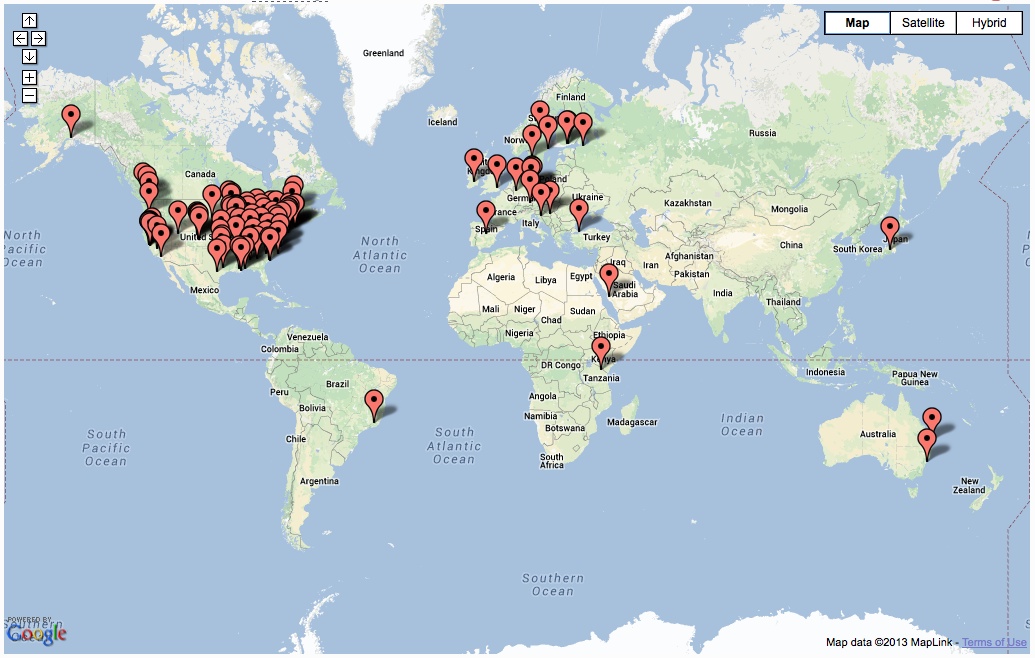
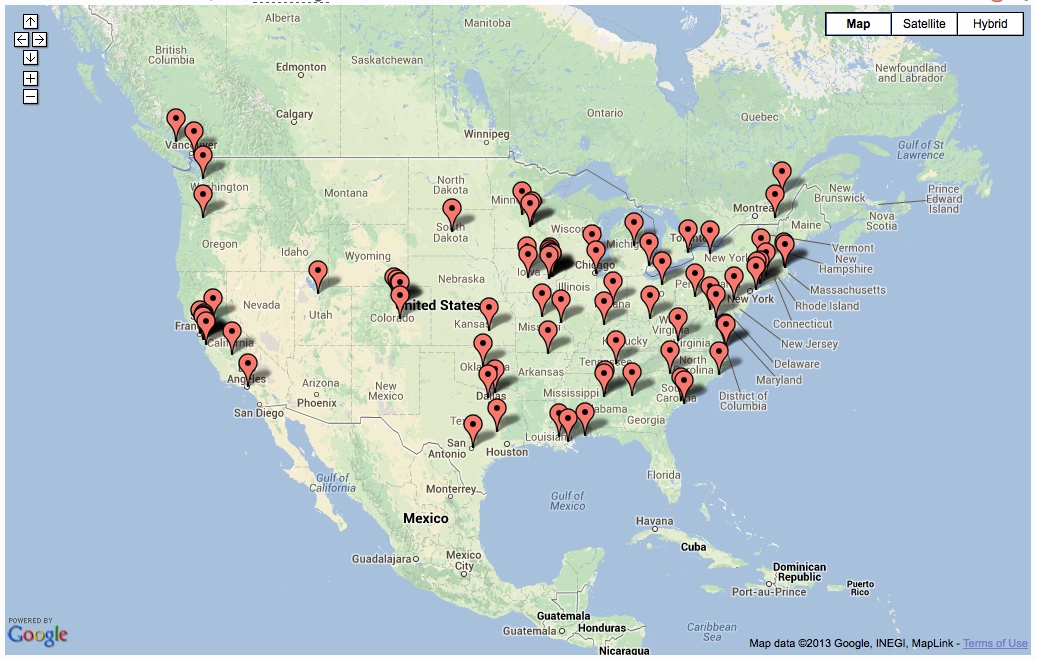
The maps below show locations for recent page visitors. Thanks to everyone who is helping promote this page.

Small House Community: Governance

20131111mo-small-tiny-house-community-governance-960x540

Introduction

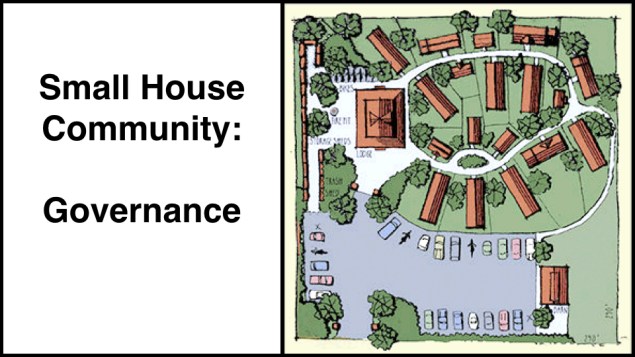
This brief article explores the topic of how a small house community might be governed. There may not be a best method of governance, but this document explores what different approaches may have to offer.

Types of Governance

Community governance generally falls into two models:

  • Central Governance and Ownership. There are many examples of centrally owned and managed communities. These are generally managed by property owners in the context of a business negotiation and contract. A camp ground, trailer court, or apartment building would be an example. The people who belong to the community may have varying degrees of influence and control, but ultimately the person or entity that owns the property will have the greatest influence.
  • Distributed Governance and Ownership. In a distributed governance system, members of the community have a more democratic ownership and influence. A free marketplace system of distributive capitalism* is almost required for this form of governance to work. In other words, when you own your home and property within a community you’ll have greater influence than if you’re renting.

Advantages and Disadvantages

Each type of governance model has benefits and drawbacks.

  • Central Governance and Ownership. Most of us have enjoyed the positive experience of renting an apartment or home. The obvious benefit of such an arrangement is the convenience found in not having to maintain the property (shoveling snow, mowing grass, repairs, and maintenance). Those wanting the greatest freedom to pickup and move find renting a freeing experience. The drawback is that money spent on housing does not build equity, and if the landlord isn’t thoughtful and efficient, the quality of life may be much less than what you’d create on your own.
  • Distributed Governance and Ownership. When you own your home, and the property it is on (or even if you rent the land),  you have greater control over your environment. In a community setting, like being an equal shareholder of a company, you have equal ownership. Condominium associations are similar to a self-governed entity where the land is equally shared. Other community models could include separate individuals purchasing land together, and then building on it. Or, a similar group of individuals could all purchase adjoining parcels, and then build on those properties. Then shared community facilities could be owned and managed by all, such as green space, recreation area, laundry facilities, large kitchen and event area. If you find yourself continually outnumbered by the majority voting on community issues, you may need to move elsewhere. Simply having a share of a community doesn’t always means you’ll get your way.

Deciding the Right Governance Model for You

Either of the above models would be a good choice, depending on the person. Over time, the same person may find one model more suitable than another as their own needs and interests change. Exploring questions identified by the factors above will help, such as how much control you’d like to have over your own land and property. Also, how willing are you to be socially engaged and somewhat interdependent upon the lives of others. Having a free-standing home on your own property without any responsibility to a condo association, neighborhood association, or other governance group would provide the greatest freedom in that regard.

Global Page Visits

In the past few hours since the above article was posted, we’ve seen a significant global interest. Thanks to everyone who has helped spread the word. Click either map below for a larger view.

20131111mo1823-small-house-community-governance-page-visits-global-1035x658

20131111mo1823-small-house-community-governance-page-visits-north-america-1037x660

__________

* Distributive Capitalism is an economic system where people have relatively equal ownership of property and business and this avoids a minority of people exploiting the majority of people.

Authentic Original Photo of Abraham Lincoln at Gettysburg Address

20131111mo-agovernmentofthepeople-960x540

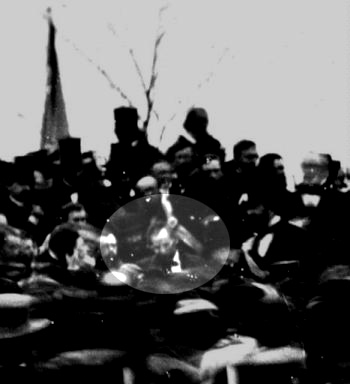
When asked, “What was the Gettysburg Address?” Some people think it’s a street address in Gettysburg where Abraham Lincoln kept a summer home. In fact, it’s a speech given on 19 November 1863 by Abraham Lincoln that inspired and reaffirmed the concept of self governance.

Surprisingly, a photo was taken of Lincoln delivering the speech. (source) That photo is shown here.

20131111mo-authentic-original-photo-of-abraham-lincoln-at-gettysburg-350x384

A Government of the People Reaches top 20 out of 300 Million on a Google Search

20131111mo-agovernmentofthepeople-960x540

Thanks!

We want to thank everyone who has helped with the launch of this website. In a relatively short period of time, since 28 October 2013, we’ve seen the site get to the top 20 list on a Google search for “a government of the people” (without quotes). Being in the top 20 out of over 300 million results is something to celebrate.

No Tricks

This accomplishment was achieved without any performance enhancing SEO tricks. Instead, we’ve simply ensured that the content is clean, focused, and as well written as possible, with effectively used keywords that stay true to the topics and mission of this website.

Our Goal

Top rankings on Google isn’t our goal. Our goal is to inspire, educate, and empower people with information that will help them achieve optimal forms of governance in their organizations, businesses, and governments. Inspired by the Gettysburg Address, this site aims to take that message and reverse engineer how one might establish and optimize a government of the people.

Search Results

Below are the search results as of 11 November 2013.

20131111mo-google-rank-government-of-the-people

Veterans Day – A Call to Wage Peace

20131111mo-veterans-day-wage-peace-with-border-960x540

The following is an excerpt from a sermon about Veterans Day by Steven Protzman, a minister at the Unitarian Universalist Society in Iowa City.

Tomorrow, Veterans’ Day, is a holiday. We take this time to remember and to honor our veterans, people who were willing to risk their lives to protect the freedoms we enjoy, the privileges we take for granted. I thank our veterans and I honor you this day, but my words, indeed any words, of thanks are not enough. Nor should we mark the day by celebrating with parades or fireworks or festive outings. Veterans’ Day and Memorial Day should be days of sorrow and repentance for all the times in human history and in American history when we settled with the sword what should have been settled with words of peace and reconciliation. These should be days to grieve our brutality and evil, our inability to find peaceful means to overcome our differences and to live in harmony with one another. These should be days in which we dare to dream of world peace, even if it seems impossible. These should be days in which we truly thank and honor our veterans by committing our lives to waging peace.

20131111mo-agovernmentofthepeople-960x540

Songs About War

20131108fr-songs-about-war-1920x1080

Music Index

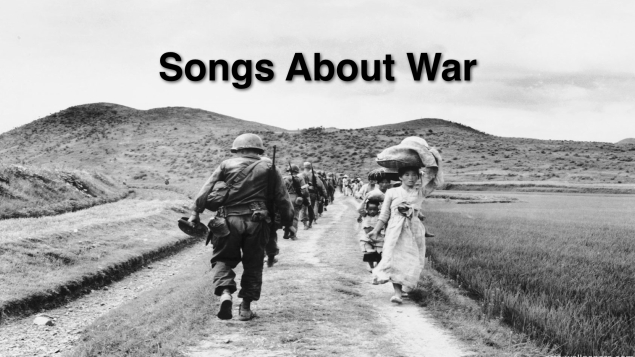
The following collection of songs presents commentary and insights regarding the impact of war on democracy. Lyrics are viewable by clicking on any song title.

  1. War” by Bruce Springsteen [Listen on iTunes Music Store]
  2. The Dogs of War” by Pink Floyd [Listen on iTunes Music Store]
  3. Till I Go Down” by Jackson Browne [Listen on iTunes Music Store]
  4. No Bomb is Smart” by Sonia Rutstein, SONiA [Listen on iTunes Music Store]
  5. It Won’t Take Long” by Ferron [Listen on iTunes Music Store]
  6. The Revolution Will Not Be Televised” by Gil Scott-Heron [Listen on iTunes Music Store]
  7. I Am A Patriot” by Jackson Browne [Listen on iTunes Music Store]
  8. The Word Justice” by Jackson Browne [Listen on iTunes Music Store]
  9. For America ” by Jackson Browne [Listen on iTunes Music Store]
  10. Lives in the Balance” by Jackson Browne [Listen on iTunes Music Store]
  11. Soldier of Plenty” by Jackson Browne [Listen on iTunes Music Store]
  12. What’s Going On” by Cyndi Lauper [Listen on iTunes Music Store]
  13. Sunday Bloody Sunday” by U2 [Listen on iTunes Music Store]
  14. Ride Across the River” by Dire Straits [Listen on iTunes Music Store]
  15. Brothers in Arms” by Dire Straits [Listen on iTunes Music Store]

iTunes Index [ Index | Top ]

Lyrics

“War” by Bruce Springsteen [Listen on iTunes Music Store] [ Index | Top ]

Spoken to crowd at live concert: “If you grew up in the 1960s, you grew up with war on TV every night – a war that your friends were involved in. I want to do this song tonight for all the young people that are out there. If you’re in your teens, I remember a lot of my friends when we were 17 or 18, we didn’t have much of a chance to think about how we felt about a lot of things. The next time, they’re going to be looking at you, and you’re going to need a lot of information to know what you’re going to want to do. Because in 1985, blind faith in your leaders or in anything will get you killed. Cause what I’m talking about here is…”

[chorus]

War

What is it good for

Absolutely nothing

War

What is it good for

Absolutely nothing

War is something that I despise

For it means the destruction of innocent lives

For it means tears in thousands of mothers’ eyes

When their sons go out to fight to give their lives

[chorus]

War

It’s nothing but a heartbreaker

War

Friend only to the undertaker

War is the enemy of all mankind

The thought of war just blows my mind

Handed down from generation to generation

Induction, destruction

Who wants to die

[chorus]

War has shattered many young men’s dreams

Made them disabled bitter and mean

Life is too precious to be fighting wars
each day

War can’t give life it can only take it away

[chorus]

War

It’s nothing but a heartbreaker

War

Friend only to the undertaker

Peace love and understanding

There must be some place for these things today

They say we must fight to keep our freedom

But Lord there’s gotta be a better way

That’s better than

War…

[chorus]

“The Dogs of War” by Pink Floyd [Listen on iTunes Music Store] [ Index | Top ]

Dogs of war and men of hate

With no cause, we don’t discriminate

Discovery is to be disowned

Our currency is flesh and bone

Hell opened up and put on sale

Gather ’round and haggle

For hard cash, we will lie and deceive

Even our masters don’t know the web we weave

One world, it’s a battleground

One world, and we will smash it down

One world … One world

Invisible transfers, long distance calls,

Hollow laughter in marble halls

Steps have been taken, a silent uproar

Has unleashed the dogs of war

You can’t stop what has begun

Signed, sealed, they deliver oblivion

We all have a dark side, to say the least

And dealing in death is the nature of the beast

One world, it’s a battleground

One world, and we will smash it down

One world … One world

The dogs of war don’t negotiate

The dogs of war won’t capitulate,

They will take and you will give,

And you must die so that they may live

You can knock at any door,

But wherever you go, you know they’ve been there before

Well winners can lose and things can get strained

But whatever you change, you know the dogs remain.

One world, it’s a battleground

One world, and we will smash it down

One world … One world

“Till I Go Down” by Jackson Browne [Listen on iTunes Music Store] [ Index | Top ]

Till I go down

I’m not gonna shut my eyes

I’ve already seen the lies

On the faces of the men of war

Leading people to the killing floor

Till I go down

Till the world stops spinning around

Till I’m six feet under the ground

Till there’s no sound

Till there’s no pain

I’m gonna swing this chain

Till I go down

I’m not gonna shut my mouth

I’m for the truth to come out

About the leader with the iron will

And his allegiance to the dollar bill

Till I go down

Till I go down

Till I go down

I’m not gonna shut my eyes

Till I go down

“No Bomb is Smart” by Sonia Rutstein, SONiA [Listen on iTunes Music Store] [ Index | Top ]

Well this is one more voice across the great big

This land is your land

and this is two more cracks across the backs

‘cause this land was my land

and it’s my time to sing now

I’m singing real loud

‘cause I’m not gonna watch this silently in pain

and I’m not gonna let this Earth go down the drain

once you bought up all the public transit tracks

so there was no way for us to get back home

had to buy a car to get to town

made sure that the bus stations all run down

well it’s my time to sing now

I’m singing real loud

‘cause I’m not gonna watch this silently in pain

and I’m not gonna let this Earth go down the drain

first you said they miscounted the votes

your brother said “no pretzels George, so you won’t choke”

how could a coup like this happen in America

“easily” that’s what the brother said “I already told ya”

it’s not about good guy

it’s not about bad guy

a brain’s a brain don’t ask me why

but if I am me and you are we

and we’re all freedom and democracy

then it’s hypocrisy to keep pushing us apart

no bomb is smart

no bomb is smart

now I’m riding on the back of a ten ton truck through Yucca Mountain

safe and quiet as a nuclear bomb or Chernobyl fountain

happy 50th birthday B-52 bomber

CNN how can you glorify this drama

Have you noticed that American’s on fire

Fueled by the high octane Bush bang bang empire

It’s not about good guy

It’s not about bad guy

A brain’s a brain don’t ask me why

well if I am me and you are we

and we’re all freedom and democracy

then it’s hypocrisy to keep pushing us apart

No bomb is smart

no bomb is smart

No bomb is smart

no bomb is smart

“It Won’t Take Long” by Ferron [Listen on iTunes Music Store] [ Index | Top ]

They said some men would be warriors

and some men would be kings

And some men would be owners of land

and other man-made things

False love as the eternal flame

would move some to think in rings

And gold would be our power

and other foolish things

But you who dream of liberty

must not yourselves be fooled

Before you get to plea for freedom,

you have agreed to be ruled

If the body stays a shackle

then the mind remains a chain

That’ll link you to a destiny

whereby all good souls are slain.

And it won’t take long,

it won’t take too long at all

It won’t take long, and you may say

“What has that got to do with me?”

and I say “You mean to tell me that’s all?”

Of three men in a desert wandering,

one is knowing and two are scared

They say time is in the river,

but the river is not there

Dry in spirit dry in body

two will lend themselves to death

And in grief one weeps into his hands

and drinks his bitter tears

‘Cause it don’t take long,

it don’t take too long at all

It don’t take long, and you may say,

“I don’t know what you’re talking about,”

and I say “You mean to tell me that’s all?”

And as I stand before you now,

I am hopeful in my rage

You know love has finally called for me,

I will not wilt upon its stage

But still smaller than my nightmare

do I print upon the page

Do we have to live inside its walls

to identify the cage?

‘Cause it takes so long,

why does it take so long,

But it takes so long, and you may say,

“I don’t really care what you’re talking about,”

and I say, “Are you trying to say you don’t belong?”

I am my mother’s daughter,

but I have seen myself in you

It’s this blessing that I follow now,

and so I must speak true

I dreamed of thousands dying,

it was you and you and you,

And while the city sleeps so quietly

there is something we must do

And it wont’ take long,

it won’t take too long at all,

It won’t take long, and you may say,

“I don’t know if I wanna know what you’re getting at,”

and it makes me wanna say, “So long.”

Because grief will come in measures,

only grief alone will know

And you’ll see it on your family,

on your own face it will grow

And they’ll try to keep you hungry,

then they’ll tell you to eat snow

You know pride can be a moving thing

if we learn the strength of “NO!”

And it won’t take long,

it won’t take too long at all,

It won’t take long, and you may say,

“I don’t think this has anything to do with me,”

“But did you ever think you could be wrong?”

At noon on one day coming,

human strength will fill the streets

Of every city on our planet,

hear the sound of angry feet

With business freezed up in the harbor,

the kings will pull upon their hair

And the banks will shudder to a halt,

and the artists will be there

‘Cause it won’t take long,

it won’t take too long at all,

It won’t take long, and you may say,

“I don’t think I can be a part of that,”

and it makes me want to say,

“Don’t you want to see yourself that strong?”

Division between the peoples

will disappear that honored day

And though oceans lie between us,

lifted candles light the way

Half will join their hands by moonlight,

the rest under a rising sun

As underneath the sun and moon,

a ritual’d wailing has begun.

And it won’t take long,

it won’t take too long at all,

It won’t take long, and you may say,

“I don’t know how to be a part of what you’re talking about,”

and it makes me want to say, “Come on!”

And beware you sagging diplomats,

for you will not hear one gun

And though our homes be torn

and ransacked we will not be undone

For as we let ourselves be bought,

we’re gonna let ourselves be free

And if you think we stand alone,

look again and you will see:

We are children in the rafters,

We are babies in the park,

We are lovers at the movies,

We are candles in the dark,

We are changes in the weather,

We are snowflakes in July,

We are women grown together,

We are men who easily cry,

We are words not quickly spoken,

We’re the deeper side of try,

We are dreamers in the making,

We are not afraid of “Why?

“The Revolution Will Not Be Televised” by Gil Scott-Heron [Listen on iTunes Music Store] [ Index | Top ]

The Revolution Will Not Be Televised

You will not be able to stay home, brother.

You will not be able to plug in, turn on and cop out.

You will not be able to lose yourself on skag and skip,

Skip out for beer during commercials,

Because the revolution will not be televised.

The revolution will not be televised.

The revolution will not be brought to you by Xerox

In 4 parts without commercial interruptions.

The revolution will not show you pictures of Nixon

blowing a bugle and leading a charge by John Mitchell,

General Abrams and Spiro Agnew

to eat hog maws confiscated from a Harlem sanctuary.

The revolution will not be televised.

The revolution will not be brought to you by the

Schaefer Award Theatre and will not star Natalie

Woods and Steve McQueen or Bullwinkle and Julia.

The revolution will not give your mouth sex appeal.

The revolution will not get rid of the nubs.

The revolution will not make you look five pounds thinner,

because the revolution will not be televised, Brother.

There will be no pictures of you and Willie May

pushing that shopping cart down the block on the dead run,

or trying to slide that color television into a stolen ambulance.

NBC will not be able predict the winner at 8:32

or report from 29 districts.

The revolution will not be televised.

There will be no pictures of pigs shooting down

brothers in the instant replay.

There will be no pictures of pigs shooting down

brothers in the instant replay.

There will be no pictures of Whitney Young being

run out of Harlem on a rail with a brand new process.

There will be no slow motion or still life of Roy

Wilkens strolling through Watts in a Red, Black and

Green liberation jumpsuit that he had been saving

For just the proper occasion.

Green Acres, The Beverly Hillbillies, and Hooterville

Junction will no longer be so damned relevant, and

women will not care if Dick finally gets down with

Jane on Search for Tomorrow because Black people

will be in the street looking for a brighter day.

The revolution will not be televised.

There will be no highlights on the eleven o’clock

news and no pictures of hairy armed women

liberationists and Jackie Onassis blowing her nose.

The theme song will not be written by Jim Webb,

Francis Scott Key, nor sung by Glen Campbell, Tom

Jones, Johnny Cash, Englebert Humperdink, or the Rare Earth.

The revolution will not be televised.

The revolution will not be right back after a message

about a white tornado, white lightning, or white people.

You will not have to worry about a dove in your

bedroom, a tiger in your tank, or the giant in your toilet bowl.

The revolution will not go better with Coke.

The revolution will not fight the germs that may cause bad breath.

The revolution will put you in the driver’s seat.

The revolution will not be televised, will not be televised,

will not be televised, will not be televised.

The revolution will be no re-run brothers;

The revolution will be live.

“I Am A Patriot” by Jackson Browne [Listen on iTunes Music Store] [ Index | Top ]

And the river opens for the righteous (5 times)

Someday

I was walking with my brother

And he wondered what’s on my mind

I said what I believe in my soul

Ain’t what I see with my eyes

And we can’t turn our backs this time

I am a patriot

And I love my county

Because my country is all I know

I want to be with my family

The people who understand me

I’ve got nowhere else to go

And the river opens for the righteous

And the river opens for the righteous

And the river opens for the righteous

Someday

And I was talking with my sister

She looked so fine

I said, Baby, what’s on your mind?

She said, I want to run like the lion

Released from the cages

Released from the rages

Burning in my heart tonight

And I ain’t no communist

And I ain’t no capitalist

And I ain’t no socialist

And I ain’t no imperialist

And I ain’t no democrat

And I ain’t no republican

I only know one party

And it is freedom

I am, I am, I am

I am a patriot

And I love my country

Because my county is all I know

And the river opens for the righteous

And the river opens for the righteous

And the river opens for the righteous

Someday

And the river opens for the righteous…

“The Word Justice” by Jackson Browne [Listen on iTunes Music Store] [ Index | Top ]

A man stands up before God and country

Raises his right hand and takes an oath

Swears he has acted in the line of duty

And he more than anyone wants to tell the truth

But there is a need to keep some things a secret

Some weapons shipments–some private wars

In the future democracy will be defended

Behind closed doors

Now the men of Congress who convene to determine

If covert war is a business or a crime

Are the same men who routinely give their permission

For the shedding of blood in security’s name

And there is a need to keep some things a secret

The names of some countries–the terms of some deals

And above all the sound of the screams of the innocent

Beneath our wheels

Does the word justice mean anything to you?

Are the features of a lie beginning to come through?

In the streets of America the children are buried

Caught in an avalanche of weapons and drugs

They live and they die in the bowels of a business

That’s disguised as a war between The Crips and The Bloods

And there is a need to keep some things a secret

The C.I.A. deals protecting the source

And the government policies directly connecting the drugs and our wars

Does the word justice mean anything to you?

As the battlefield comes home and democracy falls through

I am waiting for the time to come

When the word will be real for everyone

And not just a word but a thing that can be done

But justice must be won

“For America ” by Jackson Browne [Listen on iTunes Music Store] [ Index | Top ]

As if I really didn’t understand

That I was just another part of their plan

I went off looking for the promise

Believing in the Motherland

And from the comfort of a dreamer’s bed

And the safety of my own head

I went on speaking of the future

While other people fought and bled

The kid I was when I first left home

Was looking for his freedom and a life of his own

But the freedom that he found wasn’t quite as sweet

When the truth was known

I have prayed for America

I was made for America

It’s in my blood and in my bones

By the dawn’s early light

By all I know is right

We’re going to reap what we have sown

As if freedom was a question of might

As if loyalty was black and white

You hear people say it all the time-

My country wrong or right

I want to know what that’s got to do

With what it takes to find out what’s true

With everyone from the President on down

Trying to keep it from you

The thing I wonder about the Dads and Moms

Who send their sons to the Vietnams

Will they really think their way of life

Has been protected as the next war comes?

I have prayed for America

I was made for America

Her shining dream plays in my mind

By the rockets red glare

A generation’s blank stare

We better wake her up this time

The kid I was when I first left home

Was looking for his freedom and a life of his own

But the freedom that he found wasn’t quite a sweet

When the truth was known

I have prayed for America

I was made for America

I can’t let go till she comes around

Until the land of the free

Is awake and can see

And until her conscience has been found

“Lives in the Balance” by Jackson Browne [Listen on iTunes Music Store] [ Index | Top ]

I’ve been waiting for something to happen

For a week or a month or a year

With the blood in the ink of the headlines

And the sound of the crowd in my ear

You might ask what it takes to remember

When you know that you’ve seen it before

Where a government lies to a people

And a country is drifting to war

And there’s a shadow on the faces

Of the men who send the guns

To the wars that are fought in places

Where their business interest runs

On the radio talk shows and the T.V.

You hear one thing again and again

How the U.S.A. stands for freedom

And we come to the aid of a friend

But who are the ones that we call our friends–

These governments killing their own?

Or the people who finally can’t take any more

And they pick up a gun or a brick or a stone

There are lives in the balance

There are people under fire

There are children at the cannons

And there is blood on the wire

There’s a shadow on the faces

Of the men who fan the flames

Of the wars that are fought in places

Where we can’t even say the names

They sell us the President the same way

They sell us our clothes and our cars

They sell us every thing from youth to religion

The same time they sell us our wars

I want to know who the men in the shadows are

I want to hear somebody asking them why

They can be counted on to tell us who our enemies are

But they’re never the ones to fight or to die

And there are lives in the balance

There are people under fire

There are children at the cannons

And there is blood on the wire

“Soldier of Plenty” by Jackson Browne [Listen on iTunes Music Store] [ Index | Top ]

God is great, God is good

He guards your neighborhood

Though it’s generally understood

Not quite the way you would

You try to take the slack

Stay awake and watch his back

But something happens every now and then

And someone breaks into the promised land

Ah, boy

This world is not your toy

This world is long on hunger

This world is short on joy

A E I O

You speak as if you know

What’s good for everyone

What’s good in what you’ve done?

What’s good about a world in which

War rages at a fever pitch

And people die for the little things

A little corn, a little beans

Ah, boy

This world is not your toy

This world is long on hunger

This world is short on joy

How much longer

You gonna keep the world hungry, boy?

You measure peace with guns

Progress in mega-tons

Who’s left when the war is won?

Soldier of misfortune

Soldier of an angry call

Soldier on foreign soil

I’m not here to fight your war

I know what you’re fighting for

Ah, boy

This world is not your toy

This world is long on hunger

This world is short on joy

How much longer

You gonna keep the world hungry, boy?

“What’s Going On” by Cyndi Lauper [Listen on iTunes Music Store] [ Index | Top ]

Mother, mother

There’s too many of you crying

and brother, brother, brother

There’s far too many of you dying

You know we’ve got to find a way

To bring back love here today

Father, father

There’s no need to escalate

You see, war is not the answer

For only love can conquer hate

You know we’ve got to find a way

To bring back lovin’ here today

Aw, picket lines, and picket signs

Don’t punish me with brutality

Just talk to me so you can see

Oh what’s going on,

What’s going on…

Mother, mother

Every body thinks we’re wrong

Who are they to judge us

Just because our hair is long

You know we’ve got to find a way

To bring some understanding today

“Sunday Bloody Sunday” by U2 [Listen on iTunes Music Store] [ Index | Top ]

I can’t believe the news today

Oh, I can’t close my eyes

And make it go away

How long…

How long must we sing this song?

How long? How long…

’cause tonight…we can be as one

Tonight…

Broken bottles under children’s feet

Bodies strewn across the dead end street

But I won’t heed the battle call

It puts my back up

Puts my back up against the wall

Sunday, Bloody Sunday

Sunday, Bloody Sunday

Sunday, Bloody Sunday

And the battle’s just begun

There’s many lost, but tell me who has won

The trench is dug within our hearts

And mothers, children, brothers, sisters

Torn apart

Sunday, Bloody Sunday

Sunday, Bloody Sunday

How long…

How long must we sing this song?

How long? How long…

’cause tonight…we can be as one

Tonight…tonight…

Sunday, Bloody Sunday

Sunday, Bloody Sunday

Wipe the tears from your eyes

Wipe your tears away

Oh, wipe your tears away

Oh, wipe your tears away

(Sunday, Bloody Sunday)

Oh, wipe your blood shot eyes

(Sunday, Bloody Sunday)

Sunday, Bloody Sunday (Sunday, Bloody Sunday)

Sunday, Bloody Sunday (Sunday, Bloody Sunday)

And it’s true we are immune

When fact is fiction and TV reality

And today the millions cry

We eat and drink while tomorrow they die

(Sunday, Bloody Sunday)

The real battle just begun

To claim the victory Jesus won

On…

Sunday Bloody Sunday

Sunday Bloody Sunday…

“Ride Across the River” by Dire Straits [Listen on iTunes Music Store] [ Index | Top ]

I’m a soldier of freedom in the army of man

We are the chosen, we’re the partisan

The cause it is noble and the cause it is just

We are ready to pay with our lives if we must

Gonna ride across the river deep and wide

Ride across the river to the other side

I’m a soldier of fortune, I’m a dog of war

And we don’t give a damn who the killing is for

It’s the same old story with a different name

Death or glory, it’s the killing game

Gonna ride across the river deep and wide

Ride across the river to the other side

Nothing gonna stop them as the day follows the night

Right becomes wrong, the left becomes the right

And they sing as they march with their flags unfurled

Today in the mountains, tomorrow the world

Gonna ride across the river deep and wide

Ride across the river to the other side

“Brothers in Arms” by Dire Straits [Listen on iTunes Music Store] [ Index | Top ]

These mist covered mountains

Are a home now for me

But my home is the lowlands

And always will be

Some day you’ll return to

Your valleys and your farms

And you’ll no longer burn

To be brothers in arms

Through these fields of destruction

Baptisms of fire

I’ve watched all your suffering

As the battles raged higher

And though they did hurt me so bad

In the fear and alarm

You did not desert me

My brothers in arms

There’s so many different worlds

So many differents suns

And we have just one world

But we live in different ones

Now the sun’s gone to hell

And the moon’s riding high

Let me bid you farewell

Every man has to die

But it’s written in the starlight

And every line on your palm

We’re fools to make war

On our brothers in arms


Impact of War on Democracy and Society: Blood on the Wire by Jackson Browne (video)

20131108fr-war-and-democracy-1920x1080

Video Assignment

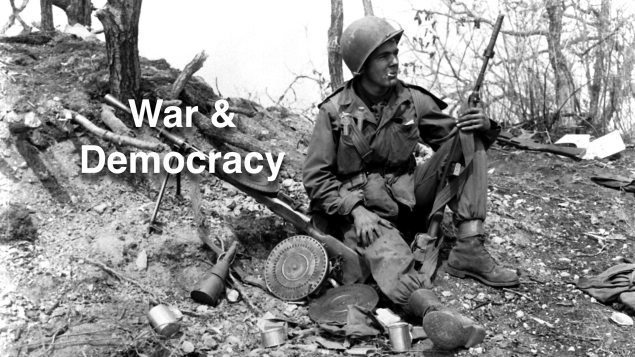
The videos below present images of war combined with the soundtrack of Blood on the Wire by Jackson Browne. Warning: Some of the images are graphic. Discussion questions are found below.

Video 1

Video 2

Discussion Questions

The following questions can be assigned as desired, depending on your curriculum or reading group interests.

  1. Sometimes special interests and corporations use their influence to have a nation’s military work to advance their profiteering and empire building. How does that effect each citizen’s perception of what their individual influence in politics can be?
  2. A nation’s military is intended to protect the citizens, and also uphold principles of democracy and humanitarian ethics around the world. When military is used to promote war for the sake of greed, how does this undermine the democratic process.
  3. It’s common for thousands of citizens to protest what they believe to be unjust wars fought using tax money from the public trust. Quite often those citizens get arrested and thrown in jail. What is the impact on the democratic process when oppressive police state tactics are used to silence citizens and prohibit their freedom of speech?
  4. Should a government order the military to go into a war if the citizens are opposed to it?
  5. Depicted in the videos above were images of children being harmed by war, and some participating in acts of violence. How does the increased militarizaiton of a nation influence how the next generation perceives diplomacy?

Captain James Yee – Guantanamo: Justice and Human Rights

20131105tu-captain-james-yee-speaking-on-guantanamo-and-human-rights-640x360

(Source: “Former Army chaplain speaks about his experiences, reads from book, Former Army chaplain speaks about his experiences, reads from book,” Iowa Now, 6 November 2013)

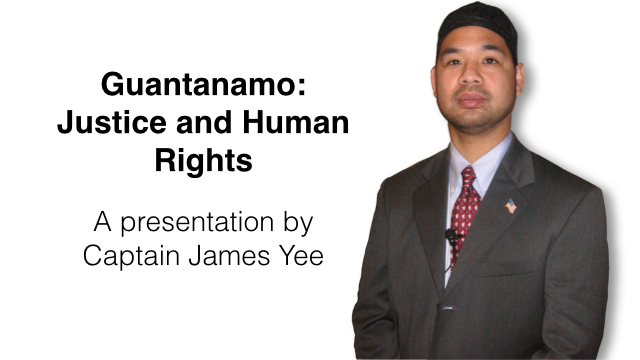
Capt. James Yee will speak on Veterans Day, Monday, Nov. 11, about his experiences as an Army chaplain at Guantanamo Bay, Cuba, at 7 p.m. in C20 Pomerantz Center on the University of Iowa campus. His talk, which is free and open to the public, is titled, “Guantanamo: Justice and Human Rights.”

Yee graduated from West Point in 1990 and converted from Lutheranism to Islam in 1991. A 14-year Army career man, he was assigned to minister to the prisoners at Guantanamo Bay after 9/11.

In 2001, Yee was commissioned as one of the first Muslim chaplains in the United States Army. Upon his return to the U.S. in September of 2003, Yee was arrested by the FBI, blindfolded, manacled, and thrown into solitary confinement for 76 days. He was accused of being an operative in a supposed spy ring. Eight months later, all charges were dropped, but his life and career were left in shambles.

Subsequently, Yee wrote a book about his experiences titled For God and Country: Faith and Patriotism Under Fire. Yee will read from his book and do a book signing Monday, Nov. 11, at 3 p.m. at Prairie Lights Books in downtown Iowa City. The reading is also free and open to the public.

His is an important message to hear for all Americans who want to protect and preserve individual constitutional rights and the rights of foreign prisoners, according to Adrien Wing, director of the UI Center for Human Rights (UICHR) and Bessie Dutton Murray Professor in the UI College of Law.

“Americans need to hear firsthand from a former Army officer about the nature of the Guantanamo situation,” Wing says. ” There are people who have been incarcerated without charges for over a decade that many of us have forgotten about. Yee, a West Point grad, makes us remember.”

Sponsors include the following, the UICHR; Veterans for Peace in Iowa City and Cedar Rapids; Iowa City Mosque; Cedar Rapids Islamic Center; Amnesty International; Iowa Physicians for Social Responsibility; the Unitarian Universalists Society of Iowa City, and Prairie Lights.

Additional events with Captain Yee will be held throughout the Iowa City/Cedar Rapids corridor from Saturday, Nov. 9 through Monday, Nov. 11. More information on his schedule is available at the UI Center for Human Rights website under News and Events.

For more information, contact Joan Nashelsky in the UICHR at joan-nashelsky@uiowa.edu or at 319-335-3900.

The UI Center for Human Rights is part of the UI College of Law.

Individuals with disabilities are encouraged to attend all UI-sponsored events. If you are a person with a disability who requires an accommodation in order to participate in these programs, contact the UICHR in advance at 319-335-3900. For accommodations to attend the Prairie Lights reading, call Jan Weissmiller at Prairie Lights in advance at 319-337-2681.

Contacts

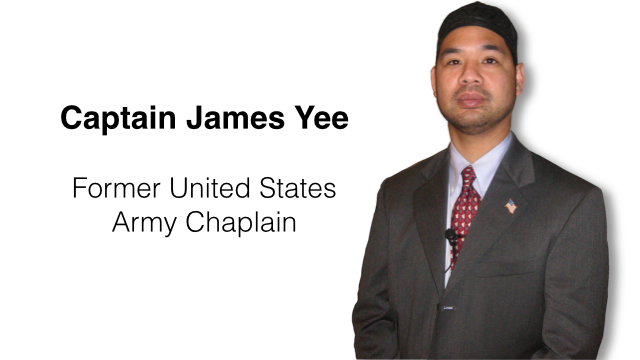
Captain James Yee

20131105tu-captain-james-yee-640x360

James J. Yee (Chinese:  or 余优素福, also known by the Arabic name Yusuf Yee) (born c. 1968) is an American former United States Army chaplain with the rank of captain. He is best known for being subject to an intense investigation by the United States, but all charges were later dropped.

Yee, a Chinese American, was born in New Jersey and raised in Springfield Township, where he attended Jonathan Dayton High School. Yee graduated from West Point in 1990.

In his appointed role as chaplain, Yee ministered to Muslim detainees held at Guantánamo Bay detention camp and received commendation from his superiors for his work. When returning from duty at the Guantanamo Bay Naval Base, he was arrested on September 10, 2003, in Jacksonville, Florida, when a U.S. Customs agent found a list of Guantanamo detainees and interrogators among his belongings. He was charged with five offenses: sedition, aiding the enemy, spyingespionage, and failure to obey a general order. These charges were later reduced to mishandling classified information in addition to some minor charges. He was then transferred to a United States Navy brig in Charleston, South Carolina. The government did not name the country or entity for whom it suspected Yee was spying.

All court-martial charges against Yee were dropped on March 19, 2004, with Maj. Gen. Geoffrey Miller “citing national security concerns that would arise from the release of the evidence,” and he was released to resume his duties.

__________

(Source: Wikipedia – James Yee)