Is the United States Controlled by an Oligarchy of Elitists?

20131119tu-oligarchy-elistists-government-960x540

An Oligarchy Defined

When one considers the political, economic, academic, and family lineage of those who have been running the country, it seems like the United States is an oligarchy of elitists.

An Oligarchy is defined as follows:

Oligarchy (from Greek ὀλιγαρχία (oligarkhía); from ὀλίγος (olígos), meaning “few”, and ἄρχω (arkho), meaning “to rule or to command”) is a form of power structure in which power effectively rests with a small number of people. These people could be distinguished by royalty, wealth, family ties, education, corporate, or military control. Such states are often controlled by a few prominent families who typically pass their influence from one generation to the next. But inheritance is not a necessary condition for the application of this term.

This most certainly defines how power and control is transferred from one generation to the next in the United States.

A Meritocracy No More

Some may question whether or not we ever were a meritocracy. With regard to the most powerful elite who run our country, An article from 2004 in The Economist about Meritocracy in America has the following statement about recent U.S. presidents:[1]

The most vivid evidence of social sclerosis comes from politics. A country where every child is supposed to be able to dream of becoming president is beginning to produce a self-perpetuating political elite. George Bush is the son of a president, the grandson of a senator, and the sprig of America’s business aristocracy. John Kerry, thanks to a rich wife, is the richest man in a Senate full of plutocrats.[2] He is also a Boston brahmin, educated at St Paul’s, a posh private school, and Yale—where, like the Bushes, he belonged to the ultra-select Skull and Bones society.

Mr Kerry’s predecessor as the Democrats’ presidential nominee, Al Gore, was the son of a senator. Mr Gore, too, was educated at a posh private school, St Albans, and then at Harvard. And Mr Kerry’s main challenger from the left of his party? Howard Brush Dean was the product of the same blue-blooded world of private schools and unchanging middle names as Mr Bush (one of Mr Bush’s grandmothers was even a bridesmaid to one of Mr Dean’s). Mr Dean grew up in the Hamptons and on New York’s Park Avenue.

The most remarkable feature of the continuing power of America’s elite—and its growing grip on the political system—is how little comment it arouses. Britain would be in high dudgeon if its party leaders all came from Eton and Harrow. Perhaps one reason why the rise of caste politics raises so little comment is that something similar is happening throughout American society. Everywhere you look in modern America—in the Hollywood Hills or the canyons of Wall Street, in the Nashville recording studios or the clapboard houses of Cambridge, Massachusetts—you see elites mastering the art of perpetuating themselves. America is increasingly looking like imperial Britain, with dynastic ties proliferating, social circles interlocking, mechanisms of social exclusion strengthening and a gap widening between the people who make the decisions and shape the culture and the vast majority of ordinary working stiffs.

Perhaps the natural progression of a society where those who have the wealth and power, retain the wealth and power, and pass it on to their family and acquaintances. They know and trust their own.

However, centralized power and control is contrary to the goals of a democratic society.

Oligarchy Turned Plutocracy

An Oligarchy need not be dysfunctional and harmful if those in leadership serve the people. However, when an Oligarchy morphs into a Plutocracy, a society can begin to crumble.

“The term ‘plutocracy’ is generally used as a pejorative to describe or warn against an undesirable condition,. Throughout history, political thinkers such as Winston Churchill, 19th-century French sociologist and historian Alexis de Tocqueville, 19th-century Spanish monarchist Juan Donoso Cortés and today Noam Chomsky have condemned plutocrats for ignoring their social responsibilities, using their power to serve their own purposes and thereby increasing poverty and nurturing class conflict, corrupting societies with greed and hedonism.” – Wikipedia, Plutocracy

Perhaps one of the strongest cases for democratic governance is the potential danger that an elitist controlled government may become a plutocracy.

__________

  1. Meritocracy in America: Ever higher society, ever harder to ascend,” The Economist, 29 December 2004
  2. “The term ‘plutocracy’ is generally used as a pejorative to describe or warn against an undesirable condition,. Throughout history, political thinkers such as Winston Churchill, 19th-century French sociologist and historian Alexis de Tocqueville, 19th-century Spanish monarchist Juan Donoso Cortés and today Noam Chomsky have condemned plutocrats for ignoring their social responsibilities, using their power to serve their own purposes and thereby increasing poverty and nurturing class conflict, corrupting societies with greed and hedonism.” – Wikipedia, Plutocracy

Abraham Lincoln Gettysburg Address 150 Year Anniversary 19 November 2013

20131119tu-abraham-lincoln-gettysburg-address-150-year-anniversary-960x540

“The world will little note, nor long remember what we say here.”
~ Abraham Lincoln, 19 November 1863

Google Cultural Institute

Googlers today may notice a link below the Google search box stating, “150 years ago, a 2-minute speech shaped a nation. Read Lincoln’s handwritten words.” The link is an invitation to visit the Google Cultural Institute where Google has assembled and elegantly delivers historic and cultural presentations. On the 150 year anniversary of the Gettysburg Address, several exhibits are featured and available online:

Full Text of Gettysburg Address

Among the many copies made of Lincoln’s Gettysburg address, the following text is considered the most accurate.

Four score and seven years ago our fathers brought forth on this continent, a new nation, conceived in Liberty, and dedicated to the proposition that all men are created equal.

Now we are engaged in a great civil war, testing whether that nation, or any nation so conceived and so dedicated, can long endure. We are met on a great battle-field of that war. We have come to dedicate a portion of that field, as a final resting place for those who here gave their lives that that nation might live. It is altogether fitting and proper that we should do this.

But, in a larger sense, we can not dedicate — we can not consecrate — we can not hallow — this ground. The brave men, living and dead, who struggled here, have consecrated it, far above our poor power to add or detract. The world will little note, nor long remember what we say here, but it can never forget what they did here. It is for us the living, rather, to be dedicated here to the unfinished work which they who fought here have thus far so nobly advanced. It is rather for us to be here dedicated to the great task remaining before us — that from these honored dead we take increased devotion to that cause for which they gave the last full measure of devotion — that we here highly resolve that these dead shall not have died in vain — that this nation, under God, shall have a new birth of freedom — and that government of the people, by the people, for the people, shall not perish from the earth.

Abraham Lincoln
November 19, 1863

“Political Gridlock” – Jim Leach Speech Transcript – Veterans Day – 11 November 2013

The following text is the transcript of a public speech delivered by Jim Leach on Veterans Day, 11 November 2013 in Iowa City. Header descriptions and links have been added to make the text more accessible.

* * *

All People are Created Equal

As this is Veterans Day, I would like to begin with an historical perspective on the citizen soldier.

Our system of government emanated from war — a revolutionary war against the then mightiest army and navy in the world. The war was precipitated by a radical idea: that all men are created equal and endowed by a Creator with inalienable rights.[1]

Rights of Life, Liberty, and the Pursuit of Happiness

I mention the intertwining of the idea framework with war for a number of reasons, the most important being that we owe our freedom to the army of George Washington and the soldiers, sailors, and airmen who followed in war -making and peace-preserving. The rights of life, liberty and the pursuit of happiness have been protected in a myriad of ways. For instance, in the 20th century our armed forces fought in two world wars, stood up to Communist aggression in two Asian conflicts, and over eight presidencies — from Harry Truman to George H.W. Bush — kept the peace during the Cold War in Europe. And at home in a traumatic moment, Dwight David Eisenhower sent the 101st Airborne to Little Rock to protect seven young black students entering a segregated high school.

Leaders and Public Servants Must Be Selfless

We owe particular respect to those who wore and continue to wear the uniform in combat, especially those who have served in circumstances where domestic dissent has been greatest. We can disagree with political decision makers but we are obligated to respect those in the armed forces who sacrificed so much for so many. Just think how much more dangerous a world we would live in if our military was as dysfunctionally organized as today’s politics and if our soldiers cared more for their self-interest than the national interest.

Two Famous Iowa City Residents

World War II ended 68 years ago, and because so few veterans of that war are still with us, I would like to reference two Iowa City residents who symbolize the greatest generation.

James Van Allen

The first is James Van Allen, the great space pioneer for whom the Van Allen Radiation Belt is named. But few in this town where he lived and worked for more than half a century knew anything about Jim’s role in World War II until a celebration of life ceremony took place at Hancher Auditorium a decade ago. Four people were asked to speak about segments of Jim’s life. The first was an elderly physicist at Johns Hopkins who surprised the packed audience by announcing that he wanted to address Jim’s time working for and then within the United States Navy, a time that he had simply noted in his c.v. had been spent as an “assistant gunnery officer.” It was a bit more than that.

The scientist told how after war broke out in Europe, Jim as research fellow at the Carnegie Institution in Washington, D.C. with a recently minted Iowa Ph.D. joined a top secret technology group called Section T of the Department of Terrestial Magnetism. Section T was part of the work associated with the National Defense Research Committee where atomic research also was supervised. The Navy had a serious problem with the effectiveness of shells shot from its shipboard cannons, and Section T was tasked to improve naval firepower capacities.

Of the shells fired from U.S. ships, fully a third either ignited in flight or failed to go off on striking a target. The German and Japanese navies had a similar but somewhat less intense problem. So Jim’s Section T group rented an abandoned Chevrolet garage in Silver Spring, Maryland and proceeded to experiment with developing a proximity fuze. Upgrading work that had commenced a few years earlier in Great Britain, the Section T group advanced the technology and solved the ruggedness problem (Jim’s principal contribution) of transferring theoretical methodology to usable weaponry. To test for ruggedness, Jim determined that he needed land to experiment upon, so he rented 40 acres of farm land in a suburban Washington county. Upon being told he should carry a firearm (in this case a .45 automatic) because of the presumed possibility that spies might be interested in his work, he was sworn in as a deputy sheriff of Montgomery County.

Working with others, he developed a proximity fuze, a key component of which he patented, that increased the effectiveness of shells from 67 percent to more than 99 percent — thereby increasing the firepower of the U.S. Navy by 50 percent.

The researchers in Section T eventually developed a ruggedly sophisticated proximity fuze, a key component of which Jim patented, that increased the effectiveness of shells shot from the navy’s long guns from 67 percent to over 99 percent —thereby increasing the firepower of the United States Navy by 50 percent. Jim’s group then turned to investigating the prospect of applying upgraded technology to anti-aircraft shells to replace the “ack-ack” we see in old World War II movies. Using radio signals to sense the presence of a plane, Jim and his Secton T colleagues developed the first “smart” precision weapon in the history of warfare.

Initially, gunners in the Pacific theater refused to use these new anti-aircraft shells. They loved their “ack-ack” because they could see how close they were coming to their targets. The problem was that the “ack-ack” pops that they could follow registered misses rather than hits. Understanding that the shells with the new detonation fuze represented a quantum improvement in anti-aircraft capacities, Jim accepted a commission as a Naval officer so that he could “commandeer” a vessel and hopscotch from ship to ship in the Pacific to persuade forces at sea to use the new technology. An inventor turned salesman, he eventually persuaded the captains and skeptical gunners to put their trust in the shells with the proximity fuze. At the same time he organized a Pacific Island supply train for the new shells and for the replacement of faulty batteries in older ones.

Only after hours of Jim’s signature low-key persuasiveness and months of trial in combat engagements in which Jim participated were the new anti-aircraft shells fully accepted by the Pacific fleet. Then, when the Japanese launched a massive kamikaze attack in the largest naval engagement in history — the Battle of Leyte Gulf — the shells with the newly developed proximity fuse helped knock down thirty-eight of the forty-one attacking planes. Until this point, any ship without air cover was a sitting duck to air attack. And when the Germans started attacking London with V-1 buzz bombs, shells with the new detonation fuze dramatically upgraded British capacities to defend the city.

In a recent biography of Jim by Abigail Foerstner, the author cites reports that the radio proximity fuze worked so well that it allowed British anti-aircraft gunners in one instance to shoot down 35 German planes in 30 minutes and in another to destroy 68 of 72 buzz bombs bound for London. The fuze was first used in land artillery in Europe by allied forces in December, 1944, at the Battle of the Bulge. The shells which were set to explode 10 feet or so above ground rather than on contact with earth were far more devastating than earlier generation shells. General George Patten later observed that “the funny fuze” had been so effective at the Battle of the Bulge that its use required a full revision of the tactics of land warfare.

At Hancher, the Johns Hopkins physicist ended his talk by reading a sentence from a citation signed by the Secretary of the Navy in 1946. It read: No one is more responsible for the success of the United States Navy in World War II than Lieutenant Commander James Van Allen.

In her biography of Jim (available on Amazon), Foerstner cites recent World War II histories noting that in the war the United States benefitted from four science and mathematical break-throughs. The first was the a-bomb; the second, upgraded radar capacities; the third, the breaking of the German and Japanese codes; and the fourth, the proximity fuse. The reason so few in Iowa City or the public ever knew about Jim’s role in the war was that the technology associated with the proximity fuse was kept top secret through the Cold War.

Jim Van Allen was Iowa-modest. And, arguably, the single most important combatant in World War II.

Donald Showers

The second Iowa City resident I would like to reference is Donald (Mac) Showers. This afternoon, a close friend of Showers, a classmate of his at City High and the University of Iowa, and fellow hero of the war in the Pacific — Col. Richard Feddersen — dropped by my office to ask if I would mention Showers’ contribution to the war effort in this Veterans Day talk. I am honored to do so.

Showers was an intelligence officer who was part of a small group responsible for breaking the Japanese code. It was the breaking of the code that made possible, for example, a preemptive strike against the Japanese fleet at the Battle of Midway where four Japanese aircraft carriers were sunk. Showers eventually rose to admiral rank and became chief of staff of the Defense Intelligence Agency and later a senior officer at the Central Intelligence Agency. He received a Distinguished Service Medal from both the Navy and the CIA.

There was a second aspect of the breaking of the German and Japanese codes that stands out. That being that we not only knew in advance about much of the key planning of our adversaries but we also knew that they didn’t know how much we knew. This knowledge was a key to strategies in the Pacific and for the landing in Normandy.

My father, for instance, a graduate of this great university and the law school where I now teach, was Executive Officer of a regiment that in its trek from Omaha Beach through Normandy and the Bulge to the Elbe came to be the fourth most casualty inflicted regiment of the war. Like so many others, Dad never spoke much of the war, but I’ll never forget the time he commented while watching a news analysis of a breaking revelation in Washington, that hundreds of Americans, including some press, must have known that Ike was planning a Normandy landing. But that secret was kept, just as was the Manhattan Project, the upgraded radar, the proximity fuse, and the code breaking. Lives were at issue, including his and so many others. Now we live in a world of wiki-leaks.

I mention these men and what they went through because we have to ask ourselves: are we letting them down?

Dysfunctional Governance

The founders envisioned a political system that divided power between branches and levels of government in order to circumscribe power and ensure that a kaleidoscope of perspectives would be considered in decision making. But no founder ever suggested that dysfunctional governance was a worthy goal. And no soldier who serves in the greatest equal opportunity employer in the world deserves to see our government shut down as life and limb is risked in combat.

Yet today we have a House divided and a Senate “snafued” by rules of its own making. These 20th-century rules do not deserve hallowed status. They were not envisioned in the Constitution. Indeed, the filibuster was originally designed to block civil rights legislation — i.e., undercut the intent of the Constitution as amended in the wake of the Civil War. In addition, various rules that are designed to enhance the prerogatives of individual senators have the effect not only of thwarting the will of the Senate but undercutting the relative position of the House of Representatives and the ability of the Executive branch to function effectively.

It is no mystery why gridlock exists and why dysfunction seems to rein. Nor is it a mystery why it matters.

Public Dissatisfaction

Public angst is understandable. After all, we have been immersed in our two longest and most debilitating wars. We have witnessed an avoidable recession and now find ourselves with high unemployment and tepid growth. Public debt has mushroomed and disparities in income grown. These circumstances have been manipulated by influence wielders who have exacerbated polarizing political trends for several decades. Now, rather suddenly, polarization is the order of the day. Matters of degree have become matters of kind.

Short Courses on Governance

To elaborate on the changing background of American politics, I developed a series of what I call two-minute courses in democratic governance when I left Congress for a teaching career.

Political Science 101

The first course I call Political Science 101. It has a mathematical dimension. Over the past generation America has been approximately one-third Democratic, one-third Republican and one-third no party. Half of a third is one-sixth. So one-sixth of America controls each of the two major parties. But in primaries where the real weakness in our democracy resides, at most one in four eligible voters participate in legislative races and often only one in eight or even less. Accordingly, if one multiplies 1/4th times 1/6th, it becomes evident that in a legislative primary with participation rates larger than average 1/24th of the electorate controls the choice of nominees.

Who is this 1/24th? In the Democratic Party it is rather liberal with consistent leadership coming from teachers, academics and union members. In the Republican Party, it is rather conservative with this philosophical term undergoing substantial change over the past generation.

When I entered politics conservatism was of a Goldwater bent — i.e, concern for military preparedness and opposition to high taxes and large social expenditures. But Goldwater’s brand of individual rights conservatism was pro-choice and pro-gay rights, views which would make him a liberal Republican outlier today.

In recent years the activism in the Republican Party has become more of a social conservative nature – i.e., pro-life, anti-gay rights, anti-U.N., with an infusion of global warming deniers. In addition, there has been a remarkable increase in the last half dozen years of libertarians who often but not always are pro-choice, pro-hemp, and less inclined to military options than either old-fashioned conservatives or liberals.

What these figures mean is that the largest group that is suddenly under-represented in Congress and increasingly state legislative chambers is the center-left and center-right who traditionally, although perhaps not now, are the largest segment of the electorate.

Political Science 102

Political Science 102 is a course about which everyone knows half, but many haven’t thought about the other half. The first half relates to presidential elections. It is generally understood that a Democratic candidate in a primary can be expected to attempt to appeal to the liberal voter and a Republican vice-versa. Once nominated, however, both can be expected to scoot a bit to the center to attract the undecided and philosophically more moderate.

But in Congressional races where 85 percent or so of all seats are safe for one party or the other, the first phenomenon (the candidate effort to appeal to the left if a Democrat and right if a Republican) also exists in a primary setting. But there is no scoot to the center in the general election or moderating in Congress because if such a movement occurs, a candidate or elected representative can expect a stiff primary opponent with significant organization and fundraising capacity to emerge. It is now primaries rather than the general election where many incumbents are most vulnerable.

Physics 101

Physics 101. Sir Isaac Newton once set forth three laws of nature, the third of which was that for every action there is an equal and opposite reaction. One day on the House floor I discovered as a pun a fourth Newt-onian Law. Watching the then Speaker of the House deliver a blistering critique of the opposition and then watching the Democratic reaction, it dawned on me that in social physics unlike natural physics reaction could be greater than action. I initially considered this was a law of partisan politics but I soon realized it also applied to relations between people in general and countries at large. If, for instance, someone calls someone else a “bum,” the chances are not insignificant that an escalated response of one kind or another may result. Likewise, if a leader calls another country “evil,” one can expect escalation of verbiage and possibly actions on the other side.

Words are Important

Why does all this matter? The health of politics in a democratic society as well as peaceful relations between nation-states is often related to the temperance of statecraft. It is also related to basic policies and governmental stability. Inability to work together and resolve inevitable differences affects reputation. Today reputation risk is high on Wall Street and in the corridors of power in Washington, D.C.

Words are important.

Thomas Jefferson in the 1800 election hired a journalist who labeled John Adams a “hermaphrodite.” Our last president, George W. Bush, was called a “fascist” and our current resident has been termed a “fascist” and a “communist,” often by the same people at the same time.

What is the matter with hyperbole? Plenty.

In Adams’ case the description was intended as a character slur. In the case of both Bush and Obama the criticism is more dangerous because the words “fascist” and “communist” have warring implications.

Four hundred thousand American patriots lost their lives defeating fascism. Tens of thousands fell and trillions of dollars were spent holding communism at bay. As for the “birther” denial that President Obama was born in Hawaii, at issue becomes the Constitutional legitimacy of the presidency.

What kind of tragic action might commence from someone who holds these kinds of views?

If all men are created equal, doesn’t if follow that it is important to respect someone else’s views even if one thoroughly disagrees? And doesn’t it follow that a better perspective can be had if one looks at anything from more than one set of eyes?

Alexandria Quartet

When I was in college, a fashionable set of books to read was the Alexandria Quartet by the British author Lawrence Durrell. Durrell wrote four books, each titled with an individual’s name, set in the years between World War I and II in Alexandria, Egypt.

Each book was about the same, rather minor happenings in an exotically vibrant city. One might wonder why read about the same events four different times.

It ends up that all four stories are dramatically different. The literary moral is that each participant witnessed happenings of the day in a different way and that to get a sense for reality it is helpful to see things from a variety of perspectives.

This is why two people in a court room may testify truthfully but quite differently to the same events. It is why it may be helpful at a dinner table, in a legislature, or in international relations to listen to what others think and say.

Understanding other perspectives is particularly important today because the challenges of mankind have undergone radical change in the capacities of warfare. In the profoundest political observation of the last century, Einstein observed that splitting the atom had changed everything except our way of thinking.

What Einstein meant was that man suddenly has developed the capacity not just to wage war but destroy all life forms. We have no choice except to change our way of thinking, and this surely begins with trying to understand how and why others think the way they do.

In Western civilization’s most prophetic poem, “The Second Coming,” William Butler Yeats observed that the center cannot hold when the best lack all conviction and the worst are full of passionate intensity.

Yeats was reacting to the seemingly senseless carnage of World War I trench warfare. But the chaos of modernity has produced a crisis of perspective as well as values that give his words contemporary relevance.

Corporate Personhood Threatens Democracy

I stray into the politics of politics because political gridlock poses a challenge to national security just as it does to domestic tranquility and because the institutional shock of our times is the undercutting of our governance ethic by the principal balancing institution in our constitutional system: the Supreme Court.

In the most irresponsible decision since the 1857 Dred Scott ruling held that a class of human beings (those of color) could be bought and treated as property, the court in Citizens United determined that a class of property (corporations) had the rights of human beings and could invest directly in politics.[2]

The court’s grant of massive new power to corporations changes the chemistry of governmental decision-making. Based on the frail assumptions that corporations are individuals and that money is speech with its use therefore protected by the First Amendment, Citizens United genetically alters our democratic DNA, pushing American politics in an oligarchic, corporatist direction.

Governance is about choice making: how to tax, what to spend, how to protect the national interest. Because the how of democratic processes impacts the what of policy (and vice-versa), changes in political dynamics are of extraordinary consequence in the determination of public priorities.

Tax policy and all areas of federal spending from education and research to national security are vulnerable to significant change due to the Citizens United ruling.

Debt is a Threat to National Security

The build-up of debt has reduced federal options. Admiral Mike Mullen, the former chairman of the Joint Chiefs of Staff, has gone so far as to suggest that our debt may currently be our greatest national security threat.

The debt issue is aggravated by the fact that the wars we have been fighting and the interventions we have been making in this new century are unique in history. No shared sacrifice by the American people was called upon.

As citizens of the first country that has ever opted to finance war with tax cuts, we have passed on to future generations the obligation to absorb the multi-trillion dollar costs of an interventionist foreign policy. We forget the lessons of the “Greatest Generation” which not only won the greatest war in history but accepted financial and strategic responsibility to help re-energize Europe and prevail in the Cold War.

Debt — its existence and management — involves two dynamic paradigms of clashing economic theory:

  • John Maynard Keynes and his most vocal modern day disciple Paul Krugman point out that in times of weak economic growth and national emergency, deficit financing can boost economic output.
  • Friedrich Hayek and his modern day disciple Milton Friedman argue that monetary stimulus is preferable to fiscal and that whatever the circumstances, care must be taken to keep taxes low.

In the crisis we have just gone through, both monetary and fiscal policies have been pressed. Federal spending has vastly exceeded revenues, federal taxes have been kept lower relative to the GDP than in the Reagan administration, and monetary policy has been expanded in unprecedented ways.

The question is now one of balance.

A modicum of consensus may be developing that the debt issue cannot be ignored. But no consensus has developed on how to constrain it and pay for everything from health care, whether or not “Obamacare” stands, to the hanging burden of our multi-trillion dollar interventionist foreign policy.

The challenge for the public is thus to galvanize a new governance ethic that recognizes that elected representatives of both parties have a mutual obligation to foster balanced decision-making without sophistically jeopardizing our debt obligations and causing government shut-downs.

Here let me mention a historical anecdote and presume a contemporary speculation.

The father of Republican economics is Alexander Hamilton. Against a populist tide, he insisted, and George Washington concurred, that we honor our Revolutionary War debt. How could a Hamiltonian not be offended by aspects of this year’s national politics?

Likewise, it is difficult to conceive how a serious disciple of either Keynes or Friedman would believe it wise to toy with bond markets with political strategies that imply that the full faith and credit of the U.S. government are in jeopardy.

Introducing uncertainty into public debt obligations has the inevitable effect of increasing the likelihood that interest rates — i.e., the costs of borrowing — will go up in the public sector with probable spiking implications for private sector borrowing as well.

Citizens could be faced with a more expensive government that delivers fewer services in an economy that supports fewer jobs. This is why the turmoil of the last month seemed so irrational to many traditional conservatives as well as modern liberals.

The moral is simple: Debt reduction is a credible, perhaps even imperative, goal, but it remains a national obligation to honor debt once undertaken and ensure that government is a stabilizing force in the economy.

The dilemma of today’s politics is that America has an abundance of leadership in commerce, science, the arts and every facet of the academy but the political system is hamstrung by ideological cleavages.

The Political Ideological Complex

President Eisenhower warned years ago of a military-industrial complex. Today my worry is more about the rise of a “political-ideological complex.” Ideologues use politicians as pawns while politicians use ideologues, especially those with deep pockets, as enablers of personal ambition. This reinforcing set of mutual interests has little to do with the common good and much to do with the break-down in civility in public life.

Basketball as an Allegory of Functional Government

Let me conclude with an observation about another element of American society that is highly competitive: sports. On Sunday, like many in this room, I went to a women’s basketball game at Carver-Hawkeye arena. Iowa was playing the 14th ranked team in the country and it was a terrifically competitive contest which the Hawkeyes won in overtime.

What stood out was the character of the individual players and how well they played together. Everyone in the home town audience admired the Hawkeye coaches and rooted for the Iowa players, but by the end of the game deep respect had also developed for the opposing team.

It was hard not to be reminded of the words that used to be oft-quoted of a long passed sportswriter named Grantland Rice who once observed that winning and losing weren’t the most important thing; what mattered most was how the game was played.

Likewise, in politics. The temper and integrity of political discourse is often more important than the precise outcome of an election or issue.

When I first entered politics I used to make one-to-one analogies between sports and politics. As time went on, these analogies broke down. Despite the publicized misbehavior of a few, sports have a far higher competitive ethic than politics.

This may be the case because most sports have referees whereas politics have none. It also relates to coaches who teach athletes how to work together and respect their opponents. In politics the analogue to coaches are campaign advisers.

There is hardly a campaign adviser in the country who doesn’t urge a candidate in a close election to go negative. But how do people and political parties come together after accentuating the negative? In the wake of so many modern elections, how does a public respect the processes, the winners as well as losers?

Putting the Common Good First

Soldiers learn that working as a unit increases the chance of prevailing in combat. Athletes learn that team effort trumps individual stardom.

Should not the common good in politics come before self, the country before party?

Thank you.

Jim Leach represented Eastern Iowa in the U.S. Congress from 1976-2006. He is a visiting professor of law at the University of Iowa College of Law.

__________

Endnotes. Below are links to additional resources referenced above.

  1. United States Declaration of Independence
  2. Corporate Personhood

“Terms and Conditions May Apply” – Documentary Film about Right to Privacy and Government Collusion with Business

20131118mo-government-corporations-terms-and-conditions-may-apply-privacy-960x540
Terms and Conditions May Apply is a documentary film about how citizens as consumers are giving away their privacy and other rights by means of software agreements and other contracts. The video is available for viewing on demand and download from Vimeo.

The movie explores how we’re enticed to relinquish our right to privacy and release our private personal data to companies that buy and resell it as a commodity.

Such practices erode democracy because they permit expansive monitoring and manipulation of people.

Efficiencies and Benefits of Dictatorships

20131118mo-dictatorships-960x540

Best Possible Outcomes

Military dictatorships and fascist regimes are generally considered less than ideal for the citizens they control. Yet, they do offer some potential efficiencies. Assuming those in control are not overly hostile or oppressive, and if they selflessly have the people’s best interests in mind, then such a government could be quite efficient and beneficial.

Effective governance requires some expertise and specialized education to gather data, interpret the data, and make determinations based on what’s in the broadest and best interest of everyone.

If highly competent, well educated, and well informed leaders are running a government, their results may be better than a country run by an under educated, poorly informed, democracy of people.

Consider this example… An auto mechanic, as an experienced specialist with the right tools, can fix your car better than 100 people without the proper tools or experience. Even if the group of 100 were to be guided by democratic principles, they couldn’t achieve what the one skilled person can accomplish.

Worst Possible Outcomes

Unfortunately, dictatorships typically use force to control the masses, and there’s little tolerance for dissent. Dictators are often not the most intelligent or capable people, but among the most conniving, militaristic, and exploitative people who take control by force sometimes combined with a controlling charismatic leadership style. This style of leadership is also employed by cults that use persuasive and charismatic religious dogma or philosophical teachings to control their members.

When wealth, ownership, and government control is in the hands of a few, but delegated out in small quantities, it can create the illusion of a democracy. In the case of a corporate controlled imperialist military empire, a nation’s military may be used for creating the conditions needed for maximum profits rather than spreading democracy and freedom.

Requirements for Better Outcomes with Democracy

It’s important to acknowledge the potential benefits of non-democratic governing. This establishes a baseline for optimal outcomes from a democratic government.

For a democracy to produce better outcomes than the best case scenario of a dictatorship, all citizens must be well educated (for critical thinking), well informed (on history and current issues), and highly motivated to be engaged in the processes of citizenship and democracy.

Religion, Virtues, Values, Morality, Public Education, and Government

20131117su-government-and-religion-960x540

Founding Principles

The government and stability of social structure in the United States are based on various foundational principles:

  • the presence of a widely available and accessible public education that creates a predominance of virtues, values, and morality engrained in all citizens who have access to a free press that informs them toward effective collective decision making

Public Education

For a democracy to be effective, people must be able to read and make informed and logical decisions. Of course there are also economic benefits to having an educated nation. For these reasons, John Adams proclaimed:

“The whole people must take upon themselves the education of the whole people and be willing to bear the expenses of it. There should not be a district of one mile square, without a school in it, not founded by a charitable individual, but maintained at the public expense of the people themselves.” ~ John Adams, 10 September 1785 (source)[1]

Virtues, Values, and Morality

Education alone is not enough to ensure that a nation can be self-govnerned. Virtues, values, and morality are required to ensure that a collective internal compass will guide people to positive, ethical, and beneficial decisions that produce optimal outcomes for all involved. The cornerstone statement on this subject was from John Adams:

“[in the absence of morality]  this country will be the most miserable habitation in the world. Because we have no government, armed with power, capable of contending with human passions, unbridled by morality and religion. Avarice, ambition, revenge and licentiousness would break the strongest cords of our Constitution, as a whale goes through a net. Our Constitution was made only for a moral and religious people. It is wholly inadequate to the government of any other.” ~ John Adams, 11 October 1798 (source)

Decisions collectively made by a majority of immoral people will be immoral. Decisions collectively made by a majority of selfish people will be selfish. Decisions collectively made by a majority of people prone to war and violence instead of diplomacy will produce strife.

The Role of Religion in Society and Government

There are many views regarding the role of religion in society and government. Some people, critical of all forms of religion, will point to internal corruption and religious wars as an example of how religions have a negative impact on society. Some countries see religion as a threat to national security and social stability. Those supportive of religion will point to the teachings on morality found in religion. Beyond intellectual teachings on morality, many religions profess that a “relationship with God” or “knowing Jesus” or “becoming one with Buddha” produce a transformational change internally to a person that results in an “encyclopedia of kindness” being written on their hearts. Like the small lump of dough used to create a new loaf of bread, the seeds of spiritual transformation can cause a person to grow into a more kind, gentle, loving, and giving individual – apart from sermons and religious texts. Some would suggest that any religion that produces positive outcomes is sufficient to promote an internal ethical compass in people. Others would argue that their own professed religion is “the only way” to salvation and social morality.

Christian Viewpoint

The following text is an excerpt from “Libations for Liberty” by pastor Brad Sherman of GetPurpose.org:

“…all power is vested in,and consequently derived from, the people; …magistrates are their trustees and servants, and at all times amenable to them.” ~ George Mason

Government being derived from the people, which translates to public servants, not Nobles, Lords and Kings, was revolutionary to politics. But what George Mason was describing was not pure democracy, a form of government that virtually all the founders considered evil. The founders understood that the Law of God which was first written on stone, had now been written upon the human heart. Therefore, government and its laws could now come from the people because God had made His dwelling place in them. This is why the American form of government was unique among the governments of the world.

Government of the people and by the people is an idea that grows directly from Christianity and Christianity alone. Only through the death of Jesus Christ, His resurrection, and His sending of the Holy Spirit to live in the hearts of men, could such a government be successful. It was true then and it is true now. Pray for a great awakening in our land.

This commentary speaks to the Christian conservative evangelical basis for the interdependence of faith and government in the United States.

__________

Disclaimer. This website does not intend to promote or favor any particular religious dogma. It’s goal is to inform and educate about a variety of issues and inspire discussion.

Source Materials. Information below is provided about source materials used for the above writing.

  1. The Works of John Adams, Second President of the United States: With a Life of the Author, Notes and Illustrations, Volume 9, by John Adams, Little, Brown, 1854, pg 540

Housing and Building Codes, Zoning Laws, and Neighborhood Covenants

20131115fr-housing-and-building-codes-zoning-laws-neighborhood-covenants-960x540

Housing and Building Codes, Zoning Laws, and Neighborhood Covenants are all intended to provide safe well-planned neighborhoods and communities that meet and maintain pre-defined aesthetic goals.

For those who have participated in their development, these laws serve a meaningful purpose. For those who come along later, such laws may seem oppressive and draconian.

In society, some laws are pushed upon us without seemingly any democratic input. However, many restrictions in our daily life are self-imposted – created either by local groups, organizations, neighborhood associations, or businesses.

Consider the increased surveillance present in many retail stores where even employees are subject to body searches and random drug testing. It’s not an oppressive government creating such conditions.

Neighborhood associations may choose 24-hour policing, surveillance cameras, and regulations dictating just about every detail of how each home is to be designed and maintained. Such circumstances can create an oppressive environment similar to a small-dictatorship where home owners are obligated by law to maintain their homes a certain way — at their own expense.

Minimum Size Standards

As with any regulations, housing and building codes can be slow to change. For example, minimum size standards are regulations that seek to ensure every dwelling has sufficient space to accommodate a universally safe, accessible, and healthy environment for a variety of residents including families. However, these laws are in conflict with the increase of demand for small and tiny homes. In the past, family sizes of 5 or more may have been typical. Today, the space needs for singles and couples are much less. The increased use of battery powered smart mobile devices and notebook computers makes it possible for people to keep their “stuff” in digital form in a much smaller place. In the past, hundreds of photos, audio CDs, movies, books, magazines, photo albums, postal mail, and other items required physical space. Today, all of these things can fit in a pocket-size or portable device. Minimum size standards need to adapt to these changes and offer provisions and accommodations for people who simply just don’t need a lot of space.

 Industry Driven Laws

Unfortunately, sometimes it seems that housing laws can be industry driven. For example, certain features of a home that might have been optional in the past, could become a requirement. If the (fill in the blank) association of manufacturers were to lobby at the local, state, and national level to ensure their products are required for use by law. In such cases, it’s not for the purpose of safety, but for profits that such laws exist. If one person has a patent on a certain product that’s required by law, then they would become quite wealthy since the conditions would be created where there would be no competition and great demand.

Manufacturers’ Interests and Eliminating Competition

Larger manufacturers with deeper pockets, may embrace costly regulations and certifications in hopes that these will place a substantial burden on their competitors sufficient to drive them out of business. For this reason, some manufacturers might even lobby at the local, state, and national level to establish such laws.

Similar trends exist in farming or software development. Consider the cost of being certified Organic, or the cost to a software developer to being Windows 8 certified. Such certifications serve a purpose, but if the certification costs are too high it will make it difficult for smaller businesses to compete.

Crowd-Sourced and Open Source Regulations

When creating regulations for any industry, it would be best to use a crowd-sourced and open-source method of establishing those regulations. Perhaps there should be regulations that define how regulations are created. In this way, one could ensure that none of the potential pitfalls (mentioned above) hinder the effectiveness and useful purpose of the regulations created.

Resources

Below are links to additional reading and resources.

Free Film Screening: Robert Reich’s “Inequality for All” on November 19 at 7PM

20131112tu-inequality-for-all-exp-20131119tu1900-1240x770

The University of Iowa Public Policy Center proudly presents a free screening of Robert Reich’s “Inequality for All” on Tuesday, November 19, 7:00 p.m, at MacBride Hall Auditorium on the Pentacrest.  The screening will be followed by a panel discussion.  Donations of non-perishable food, paper products or baby items are requested for The Crisis Center of Johnson County.

“Inequality for All” examines the widening income inequality in the United States, presented by Robert Reich – an American economist, author and professor at Harvard and Berkeley, and U.S. Secretary of Labor under Bill Clinton.

At the heart of the film is a simple proposition: What is a good society and what role does the widening income gap play in the deterioration of the nation’s economic health?

Individuals with disabilities are encouraged to attend all University of Iowa-sponsored events.  If you are a person with a disability who requires an accommodation in order to participate in this program, please contact Leslie Gannon in advance at (319) 335-6817 or leslie-gannon@uiowa.edu.

For more information, please visit: http://ppc.uiowa.edu/forkenbrock/inequality-all

Co-sponsored byUniversity of Iowa College of Public Health, The Obermann Center for Advanced Studies, University of Iowa Department of Sociology, University of Iowa Center for Human Rights, University of Iowa Office of the Provost, University of Iowa Department of History, Tippie College of Business Department of Economics, University of Iowa School of Social Work, University of Iowa School of Urban and Regional Planning, University of Iowa Gender, Women’s and Sexuality Studies, and FilmScene.

__________

The above information is provided by the University of Iowa Public Policy Center.

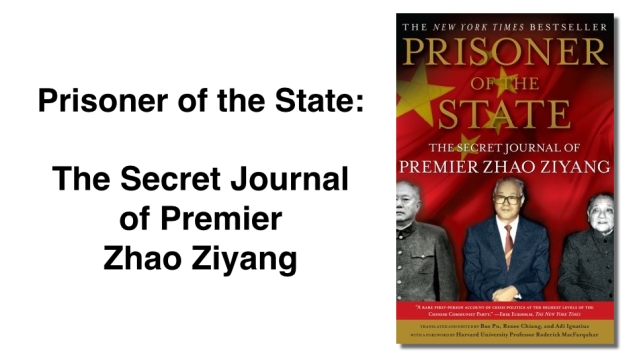
Prisoner of the State: The Secret Journal of Premier Zhao Ziyang

20131112tu-prisoner-of-the-state-the-secret-journal-of-premier-zhao-ziyang-960x540
Prisoner of the State: The Secret Journal of Premier Zhao Ziyang is a historic novel based on dozens of audio recordings from Zhao Ziyang. [Amazon]

Following Zhao Ziyang’s public statement at the Tiananmen Square protest, Zhao was removed of all positions in government and placed under house arrest. For the next sixteen years of his life, Zhao lived in forced seclusion in a quiet Beijing alley.

Although minor details of his life leaked out, China scholars lamented that Zhao’s account of events was to remain unknown. Zhao’s production of the memoir, in complete secrecy, is the only surviving public record of the opinions and perspectives Zhao held later life in life.

Zhao began secretly recording his autobiography on children’s cassette tapes in 1999, and eventually completed approximately thirty tapes, each about six minutes in length. Zhao produced his audio journals by recording over inconspicuous low-quality tapes which were readily available in his home: children’s music and Peking Opera.

Zhao indicated the tapes’ intended order by faint pencil markings, and no titles or notes on how Zhao intended the tapes to be otherwise interpreted or presented were ever recovered. The voices of several of Zhao’s closest friends were heard in several of the later tapes, but were edited out of the published book in order to protect their identities.

After the tapes’ creation, Zhao smuggled them out of his residence by passing them to these friends. In order to minimize the risk that some tapes might be lost or confiscated, each participant was only entrusted with a small part of the total work.

Because he could only produce the tapes during periods in which his guards were absent, the process of recording the tapes took over a year. Bao Pu, one of the editors who worked on publishing Zhao’s memoir, first learned of the tapes’ existence only after Zhao’s death on January 17, 2005.

It took several years for Bao to collect them and gain legal permission from Zhao’s family to publish Zhao’s autobiography. Zhao’s family has always maintained that they were completely unaware of the tapes’ existence until contacted by Bao Pu. After Zhao’s death a second set of tapes (perhaps the originals) were found in Zhao’s home, and were returned to Zhao’s family.

__________

The above text is an excerpt from Wikipedia. (source)

Four Modernizations: Agriculture, Industry, National Defense, Science and Technology

The Four Modernizations were goals first set forth by Zhou Enlai in 1963, and enacted by Deng Xiaoping from 1978, to strengthen the fields of agricultureindustrynational defense, and science and technology in China. The Four Modernizations were adopted as a means of rejuvenating China’s economy in 1978 following the death of Mao Zedong, and were among the defining features of Deng Xiaoping‘s tenure as head of the party.

Summary

They were introduced as early as January 1963: at the Conference on Scientific and Technological Work held in Shanghai that month, Zhou Enlai called for professionals in the sciences to realize “the Four Modernizations.” In February 1963, at the National Conference on Agricultural Science and Technology Work, Nie Rongzhen specifically referred to the Four Modernizations as comprising agriculture, industry, national defense, and science and technology. In 1975, in one of his last public acts, Zhou Enlai made another pitch for the Four Modernizations at the 4th National People’s Congress. After Zhou’s death and Mao’s soon thereafter, Deng Xiaoping assumed control of the party in late 1978. In December 1978 at the Third Plenum of the 11th Central Committee, Deng Xiaoping announced the official launch of the Four Modernizations, formally marking the beginning of the reform era.

The science and technology modernization although understood by Chinese leaders as being key to the transformation of industry and the economy, proved to be more of a theoretical goal versus an achievable objective. This was primarily due to decades-long isolation of Chinese scientists from the western international community, outmoded universities, and an overall lack of access to advanced scientific equipment, information technology, and management knowhow. Recognizing the need for technical assistance to spur this most important modernization, the Chinese Government elicited the support of the United Nations Development Programme (UNDP) in the fall of 1978 to scope out and provide financial resources for the implementation of an initial complement of targeted projects. The initial projects from 1979-1984 included the establishment of overseas on-the-job training and academic programs, set-up of information processing centers at key government units, and the development of methods to make informed decisions within the Chinese context based on market principles. The key advisor to the Chinese Government on behalf of the UNDP was Jack Fensterstock of the United States. This first technical assistance effort (CPR/79-001) by the UNDP led to the entry of large-scale multilateral funding agencies including the World Bank and the Asian Development Bank.

The Four Modernizations were designed to make China a great economic power by the early 21st century. These reforms essentially stressed economic self-reliance. The People’s Republic of China decided to accelerate the modernization process by stepping up the volume of foreign trade by opening up its markets, especially the purchase of machinery from Japan and the West. By participating in such export-led growth, China was able to speed up its economic development through foreign investment, a more open market, access to advanced technologies, and management experience.

Controversy

On December 5, 1978 in Beijing, former red guard Wei Jingsheng posted on theDemocracy Wall the Fifth Modernization as being “democracy”. He was arrested a few months later and jailed for 15 years.

References

Further reading

  • Hsü, Immanuel C. Y. (2000). The Rise of Modern China (6th ed.). New York: Oxford University Press. ISBN 0-19-512503-7.
  • Evans, Richard (1995). Deng Xiaoping and the Making of Modern China(2nd ed.). London: Penguin Books. ISBN 0-14-013945-1.

__________

The above text is taken from the following Wikipedia entry: http://en.wikipedia.org/wiki/Four_modernizations